Siesta Culture

I have always struggled with taking classes or going to work in the later afternoon. An hour or two after lunch, I start to experience a major dip in my energy and have a hard time staying focused. Usually, I have to power through it and keep going, but I always enjoy relaxing outside or laying down for an hour in the afternoon if it’s possible.

When I studied in Italy, I discovered the siesta culture of the Mediterranean area and southern Europe. It’s not as pronounced in Rome as it is in smaller towns throughout Italy or in Spain, but it was a culture shock for me to see shops and restaurants close between 2 and 4 pm. The crowds in the streets thinned, especially away from the tourist-y areas, and it was common to see people on their balconies.

On days when I didn’t have class, I started to use this down time to rest, take a peaceful walk, or hang out with my roommates. It was very nice to have a block of time with limited options of places to go since it forced me to slow down and rest in the middle of the day. Once I travelled to Spain for a week and experienced a much more obvious culture of the mid-day rest, I got interested in the siesta culture. To me, this seemed like a leisurely way to live: using the afternoon to rest and staying out later into the evening. However, my research into the topic found that the siesta culture is mostly influenced by geography.

In Mediterranean countries like Spain and Italy, the heavy heat in the afternoon can make it unpleasant to be outside. This combined with the heavier dishes common in those areas means that people experience a dip in energy after lunch. The custom began with the Romans, which is where the word siesta comes from. The mid-day nap is common in other countries outside of that region as well. There are similar customs in Egypt and other Middle Eastern countries. It is also common in China to take a short nap after lunch.

Taking a break to rest in the middle of the day has a lot of benefits. A short nap can help with memory, emotional regulation, cognitive ability, and reduction of stress. It is better for a person’s mental health to have a break to de-stress in the middle of the day instead of working straight through the day with only a short lunch break. It can also help with boosting energy later in the day.

I believe that introducing a siesta culture into the United States could be beneficial for a lot of people. A lot of the U.S. is as hot or hotter than countries like Spain and Italy, so it would have similar benefits to get people out of the heat. American culture is also very work- and productivity-focused, and making a conscious effort to rest during the workday might help reduce the pressure a lot of people feel to overperform. Even if people don’t use the break to nap, they could take the time to do something that they enjoy and find relaxing, such as reading a book or taking a walk. We could learn a lot from countries like Spain to reduce daily stress and improve American culture.
German Club Involvement

This semester I continued with my role as the German tutor through the Academic Success Center, holding two two-hour tutoring sessions every week in Kaufman hall. Despite the fact that I know there are many students struggling to meet the expectations of a committed learner in beginning, intermediate, and advanced classes, the attendance at my tutoring was abysmal. I advertised to almost every class at the beginning of the semester, but I usually had only regulars, or someone who never came back. With returning students, I often felt like the effort was not being put in between sessions to see any real improvement. Having a language requirement for college is a key part of a well-rounded education, and being a part of the arts and sciences college and Modern Languages department adds to how connected I feel on campus, but for many students it seems too far out of their comfort zones. College is a place you have to grow, and you HAVE TO WORK FOR IT!!!! 

If you are enrolled in a language class and struggling, try harder NOW before you’re 3 semesters deep and unable to string together a single sentence. We all learned how to speak to get here, and struggling to learn a language is an excellent exercise of empathy as a member of the global community. 

I also attended a film screening from Frau Preuss and Stammtisch, for the first time! Not sure if I will go back again, but next year I will be living closer to Main Street so it is plausible!!

In other news, I won the German Club award again this year, and enjoyed the MLLL Banquet and Awards Ceremony. I will try to promote tutoring again next semester, and stay involved in German Club.

Audrey Hirchert-Walton

Cinco de Mayo and What it Really Celebrates

Cinco de Mayo is an extremely popular holiday in the United States. People get together to have “Mexican-themed” parties, usually involving tacos or other Mexican foods, mariachi or banda music, and, most or all, alcohol, especially margaritas, beers imported from Mexico, and tequila. However, many Americans don’t know what Cinco de Mayo even celebrates.

A common misconception is that the holiday is celebrating Mexican Independence. I’m not sure how this misconception began, but I can understand how many Americans compare the holiday to our Fourth of July and assume they are celebrating the same thing. The thing is – Mexican Independence Day is actually on September 12th. Cinco de Mayo celebrates the Battle of Puebla and the Mexican victory over the French.

In 1861, Napoleon III invaded Mexico after Mexico was forced to default on loans from several European countries during bad financial times in the country. Napoleon wanted to use the opportunity to take control of Mexico as a territory. The French forces greatly outnumbered the Mexican forces, which forced them to retreat from Juarez, the site of the invasion, to Puebla. However, the Mexican army managed to defeat the larger French army at the Battle of Puebla on the 5th of May. France had three times the men but suffered five times the number of casualties.

This battle did not end the war. France didn’t leave Mexico until 1867, when a combination of factors such as a need to focus on fights on the European front and pressure from the United States forces them to remove troops from Mexico. What the Battle of Puebla did accomplish is delay the French invasion of the capital as well as becoming a symbolic victory.

In Mexico, Cinco de Mayo is not a very large holiday. In Puebla, people celebrate the victory with military re-enactments, and there are a few other celebrations throughout the country, but it is not as big of a deal as it is in the United States. Independence Day is much more widely celebrated, as it marks the beginning of the Mexican War of Independence. On the evening of September 15th, the Mexican president rings the Bell of Hidalgo and recites the Grito de Dolores. This is a re-enactment of the call for independence that Miguel Hidalgo recited to call for the beginning of the war. That night and the following day, there are fireworks shows, parades, and many other festivities.

In the United States, the widespread celebration of Cinco de Mayo rather than Independence Day began with Mexican-American activists who identified with the victory of the Mexican army over French forces. From there, it has became a holiday to celebrate Mexican culture and Mexican-Americans across the United States. Festivals, parades, and parties are held to preserve Mexican culture in America.

Although it is a common topic of discussion of whether Cinco de Mayo is a worthy holiday to celebrate since it is not a large holiday in Mexico, I think that celebrations that avoid commercialization and objectification are valuable. In today’s world, where Mexican-Americans and all Hispanic Americans are being targeted by the government and immigration forces, it is more important than ever to lift up the culture that is distinctly Mexican-American and has been a cornerstone in American culture for a long time. Both immigrants and Mexican-Americans who have lived in the United States for generations (even since Texas and other formerly Mexican or Spanish territories joined the U.S.) bring something valuable to the country and should be celebrated and protected.

Bastille Day (July 14)

As I prepare for my study abroad in Paris, I am becoming increasingly interested in staying up to date with French holidays—especially Bastille Day. Commemorating the 1789 storming of the Bastille prison, a turning point in the French Revolution, symbolizing the end of royal tyranny and the birth of a new era.

Today, the holiday is celebrated with~

  • Traditional Picnics: Gathering over wine, fresh bread, and sophisticated cheeses.
  • Public Festivities: Lively “Bals des Pompiers” (Firemen’s Balls) and communal dancing.
  • Grand Finales: Spectacular fireworks displays illuminating the Eiffel Tower.

I won’t be able to witness the festivities in person this year as I will be back home before the celebration begins. It is an honor to learn about such an important tradition, and I hope to one day have the privilege of celebrating it in France myself.

Bonne Fête Nationale!

Best regards,

Pira Tsui

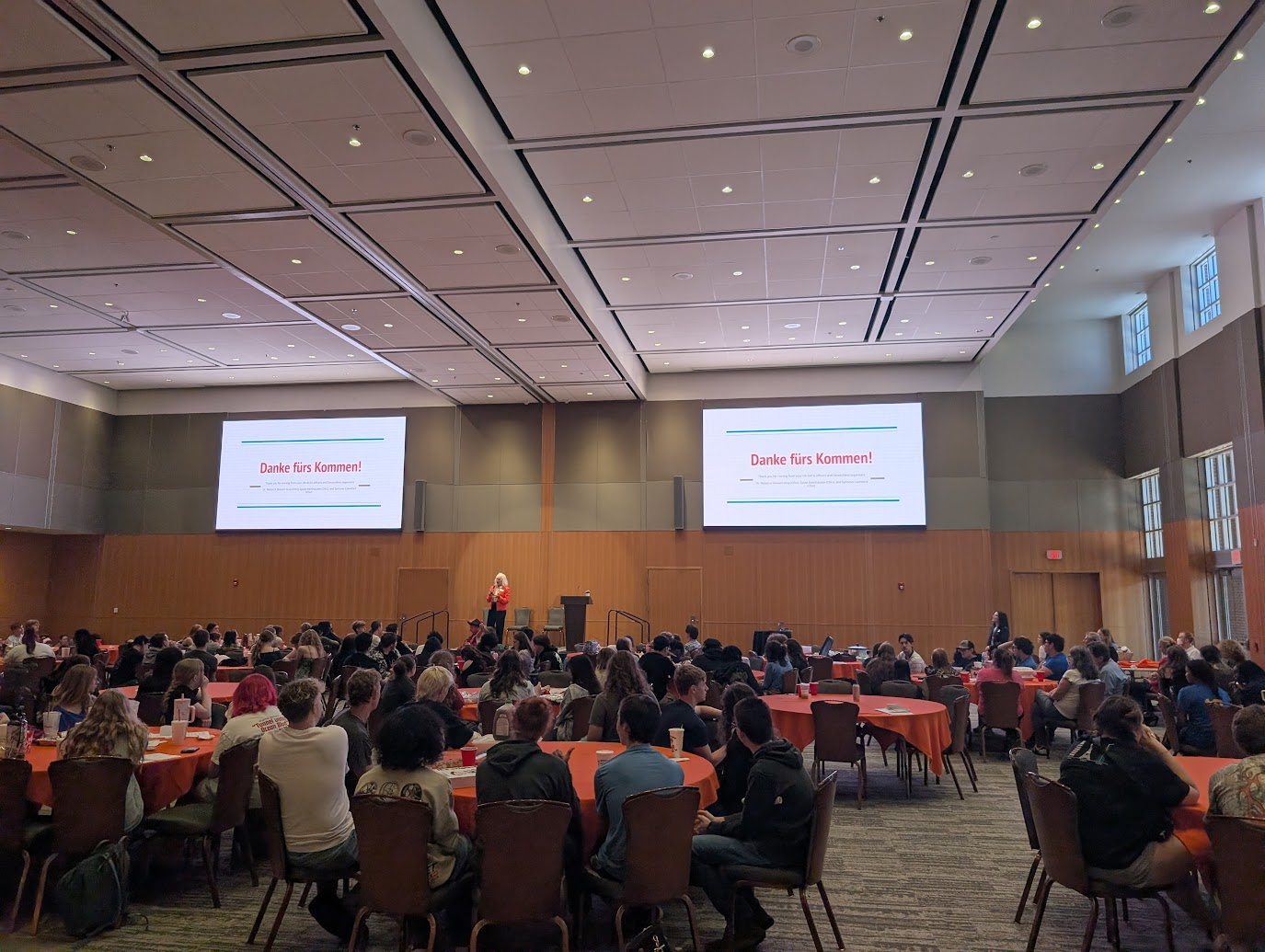
German Club Deutschfest 2026

Another year, another Deutschfest! I carpooled with Lorren to the classic OnCue in OKC and then we drove with Dr. Bangor to OSU campus. 

Deutschfest is an annual event hosted by the OU, OSU and UCO German departments which hosts high school German students from high schools around Oklahoma in a day long field trip. We provide lunch and opportunities for learning challenges and competitions. Students have the option to submit a piece of artwork or a baked good to be judged, or participate in music performance or poetry recitation competitions, which they prepare for ahead of time. The other challenges include vocabulary tests, listening comprehension, and grammar focused jeopardy. 

This year I was the host of the “Draw What You Hear” station, and it was honestly lucky that I am as proficient in German as I am, because the pre-recorded tracks we were meant to play were nowhere to be found, so I just read the passages aloud. The task was to listen to each passage read aloud 3 times, and color in a worksheet or draw the scene described. There were 4 different rounds which varied in difficulty. Students at the easiest level had to fill out a family tree, and at the hardest had to draw a complicated scene of a vacation on a beach. I had fun, graded the drawings to award prizes, and got to present the awards. 

During lunch we also were able to sample what was left of the baked goods, view the art, and chat with professors and high schoolers. They also had a scavenger hunt they could fill out to win a prize, which included asking volunteers from each school a fun fact about their university. As always, I had a lot of fun, and will be helping out again next year when it returns to UCO!

Summer Holidays Around the World

As summer approaches, I have begun to feel more energetic and excited to get out of the house and into the nice weather. For me, the start of summer manifests as looking for anything at all to celebrate – end of the school year parties, first day of summer picnics, days at the lake where I tell myself I’m celebrating Memorial Day or Fourth of July, but really I just want an excuse to sit out by the water. In the spirit of warm weather and the urge to celebrate anything and everything, I decided to research summer holidays around the world.

One of the most well-known summer holidays outside of the United States is the Midsummer celebration in Sweden. This holiday falls on what is usually considered the first day of summer, contradictory to the holiday’s name, or the summer solstice. The solstice is the longest day of the year, and in ancient and medieval Sweden it was considered a night of magic. There were many spells and rituals associated with the day, such as picking flowers and other plants that had medicinal powers or were used to tell the future. More well known is the tradition of dancing around a maypole, a tradition that continues to this day in Sweden and around the world. In modern day, Swedes continue to celebrate the holiday by eating seasonal foods such as potatoes and strawberries in large outdoor gatherings. They also play different games outside to enjoy the good weather and long hours of sunshine.

Another solstice celebration comes from the Incan Empire, although it is still celebrated in Peru today. Inti Raymi, or Festival of the Sun, was a religious celebration honoring the sun god Inti. However, unlike Midsummer in Sweden, Inti Raymi is celebrating the shortest day of the year since Peru is in the southern hemisphere. This is an important day because it marked the Incan New Year, when the days would begin to lengthen again. Today, the holiday is largely a historical re-enactment. When the Spanish colonized much of South America, they banned the celebration for being idolatrous. It wasn’t until 1944 when artists began to restart the celebration based on historical accounts. The Inca and his wife and army follow a procession throughout the day to different places in the city of Cusco and complete different rituals. The festivities involve much dancing and many colors.

A more modern holiday is Panafest, which is a Pan-African celebration held in Ghana every other summer. Began in 1992, Panafest was created to unite the African diaspora and celebrate its culture and history. Above all, it is meant to help heal the trauma experienced by the diaspora during the colonization of Africa and the Atlantic Slave Trade. Panafest addresses global issues, remembers the past and the resilience of the African people, and highlights the art and life of Africans on the continent and abroad.

Lastly, Obon is a three-day lantern festival in Japan. The dates vary throughout the country depending on the calendar used, but it usually falls in August or late July. The holiday comes from the Buddhist custom of welcoming the spirits of deceased loved ones. Altars, lanterns, and dances are used to call back the spirits of loved ones, especially those lost in the part year. Today, it is common to find a carnival to celebrate Obon with food, lights, and games.

I hope that learning more about different festivities around the world inspires you to find new things to celebrate, or even just research. There is so much more to learn about the countless holidays and the histories behind each one.

The Beauty of Listening to Music In Other Languages

Did you know there are people that only listen to music in one language? They choose not to listen to music in other languages because they can’t understand it. They always say the same thing: why would I listen to it if I don’t understand what’s going on.

Here’s what I think: music is universal. It doesn’t matter if you can’t understand the lyrics. Music is something that you feel. You can feel the emotions of a song even if you don’t get the words. In the end, do lyrics really matter if you like the sound of a song? Even if lyrics are really important, in this day and age it’s quite easy to look up the translation of a song. When you do that you’ll find a treasure trove of beautiful messages. It really is that easy. 

All my life I have grown up listening to music in a variety of languages. From Spanish to Thai, you name it. I’m always open to new music and languages. I’ve discovered some of my favorite music just by branching out and keeping an open mind. It’s also a great way to discover different genres of music, instruments and artists. 

Who knows? You might be one language away from finding your favorite artist. 

Listening to music in foreign languages also allows you to immerse yourself in other cultures. This in turn broadens your worldview and challenges your existing beliefs. It’s also a useful tool for language learners! 

Music is an incredibly important part of most cultures. It truly connects us in a unique and powerful way. 

Thanks for reading!

Yailin

Why Most Mexicans Don’t Celebrate Cinco de Mayo

In the United States there are many people, especially non-Mexican people, who celebrate Cinco de Mayo by going to their local Mexican restaurants and ordering food and so on. The reality is, in Mexico, Cinco de Mayo isn’t widely celebrated. 

Let’s clear up some misconceptions. Cinco de Mayo is not Mexico’s independence day. It isn’t the fourth of July equivalent like some people believe. It’s not even a national holiday. 

So, what exactly is it? 

Cinco de Mayo celebrates the Mexican army’s victory over French imperial forces at the Battle of Puebla in 1862 during the Franco-Mexican War. 

In Mexico, Cinco de Mayo is viewed more as a state holiday, celebrated primarily in the state of Puebla. Although, other parts of Mexico celebrate as well. The holiday is often celebrated with military parades and scene reenactments. 

However, for a majority of the population, May 5th is just another work day. Since it is not a national holiday, banks, offices and stores remain open. 

While Cinco de Mayo is not widely celebrated in Mexico, it has become incredibly popular abroad. In the U.S. the holiday is seen as a celebration of Mexican culture and heritage. Celebrations often involve music, food and more. 

Mexico’s Independence day is actually on September 16th not May 5th. It marks the beginning of the Mexican War of Independence. On this day in 1810,  Miguel Hidalgo y Costilla called for a revolt against the Spanish empire. Every year on the night of September 15, the Mexican president will reenact the Grito, yelling “¡Viva México!” 

Hopefully you have a clearer idea of Mexico’s independence day and Cinco de Mayo!

Thanks for reading!

Yailin

OU Cousins

This Spring was my fourth semester as a member of the international club, OU Cousins. As a freshman I became “cousins” with a student from South Korea. I got to know her and her culture and we became good friends. In fact, this past summer I went to South Korea to study abroad for a month. While I was there I got to see my friend twice! Together we explored Seoul and tried a lot of delicious foods.

This year I wasn’t too worried about getting an official cousin. I decided I would try to make more friends through the club. I went to the match party last semester with two friends, both of whom are also from the United States. Unfortunately, I wasn’t able to go to the match party this semester because of class I had. However, I was able to make a few friends last semester that I have kept in touch with over the school year. 

I made a friend from Japan who was, coincidentally, in my friend’s class last semester. I’ve gotten to learn more about Japanese culture through him and he’s helped some friends and I by explaining some of the grammar patterns we’ve learned in class. He’s really nice and does a good job at explaining things. He’s definitely the reason we all did really well on our Japanese finals last semester! A few of my friends (from my Japanese class) actually had the opportunity to go to Dallas and bring him with us. It was a really fun time and we even went to a photobooth to take pictures! Trying to fit everyone into the frame was a bit of a challenge though. 

My other friend/ unofficial cousin (we never actually filled out the form, both of us forgot) is from South Korea. We were able to go to OU Cousingiving together last semester and it was really fun. He’s a very easy-going person who is always down to do anything. At one point, I took him to a Korean restaurant to see if he would like it, in comparison to the food in Korea, and he did. 

Overall I’m pretty happy to be part of OU Cousins, I think it’s a lot of fun and you can make a lot of really great friends out of it.

Thanks for reading!

Yailin

おにぎり- Onigiri Workshop

In March, the Japanese department hosted an onigiri workshop open to any student taking a Japanese language course. We made and ate onigiri (おにぎり)! 

Onigiri is believed to have originated in the Yayoi period, approximately 2000 years ago. Originally, the rice was shaped into balls and served as easily transportable snacks for travelers and soldiers. During the Edo period (1603-1867), people began wrapping the onigiri in seaweed, a feature commonly recognized in the onigiri today. During this time period the triangle shaped onigiri we’re familiar with now became popular. 

In the workshop we made furikake onigiri which is made by mixing rice with Japanese seasoning called furikake. There was also rice mixed with red shiso or perilla leaves. Both were very good. The rice was already made when we arrived. All we had to do was shape the rice into a triangular shape and wrap it in seaweed. It sounds simple enough but getting it perfect can be a little hard. It was still very fun! 

Onigiri is often made with a variety of fillings including salmon, umeboshi and tuna. The onigiri often sold in convenience stores in Japan usually have filling in them. My favorite filling is tuna mayo. I probably had at least one onigiri every day when I was in Japan. I had the chance to try onigiri from convenience stores and restaurants. Honestly, both were incredibly delicious. It really is the perfect snack: easy to carry around, eat and it’s good.

The workshop was really fun! Now I’m really craving onigiri!

Thanks for reading!

Yailin Serrano