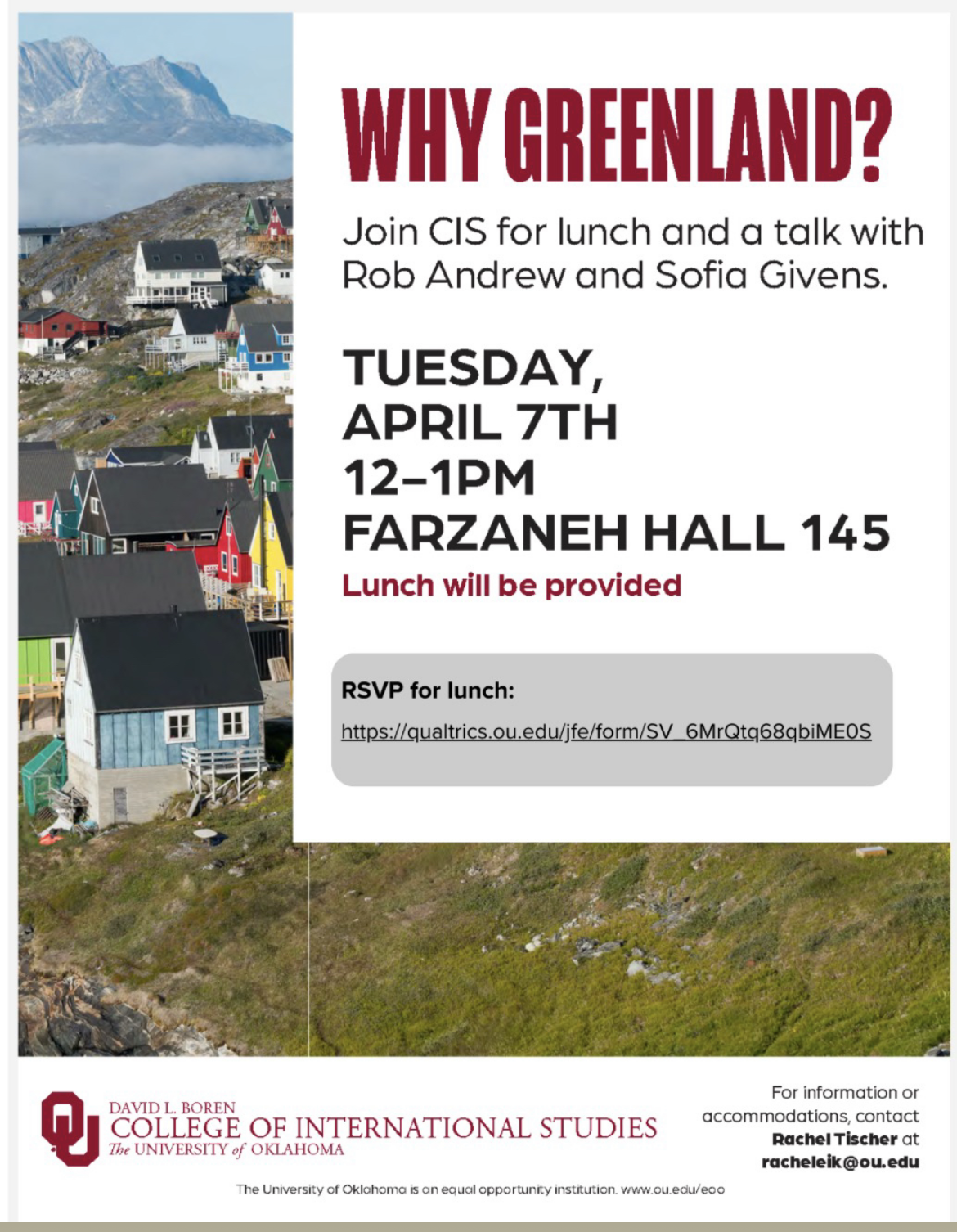
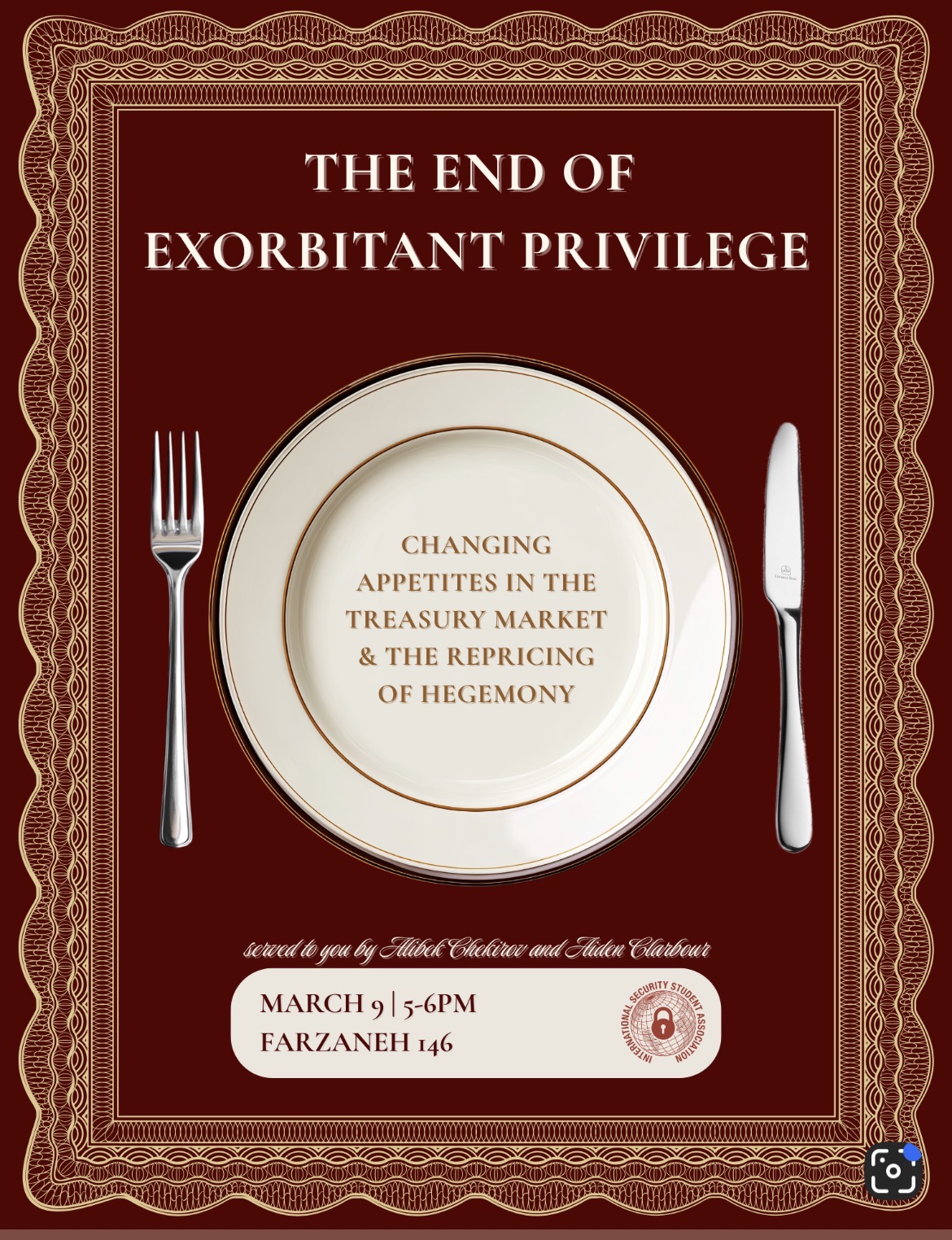
Alas, due to a scheduling conflict this semester, my attendance at ISSA was not what I would have liked it to be. However, I did attend three events either hosted or promoted by ISSA, flyers of which are depicted below. Overall it was a good experience for me, leadership honestly seems to me made up of really cool, smart people. I used to be in debate in high school, and we would do a lot of research on how specific policies would affect the international landscape, so hence my interest in this sort of topic. The intersection of one of my majors with one of the events (the discussion of the U.S treasury market) was really interesting to see too.
A Personal Anecdote
The “Why Greenland” talk somehow ended up being the most intimidating event out of all of these. To set the scene, all of these CIS professors were sitting there in business casual and talking about international politics, and otherwise the room was mostly full of middle-aged adults and upperclassmen. Cue me in my wolf t-shirt and black jean jacket, taking fervent notes like some kind of amateur journalist, nodding very coolly along, and going “I researched arctic oil drilling in high school debate! Who knew it would be so applicable!” I kid, it was a really well-researched and interesting event, I just felt a bit underdressed while it was happening.
Other Events
For the bake sale I mostly just swung by after class, but you can see kind of what it was about on the flyer above. And see my other blog post for my thoughts on “The End of Exorbitant Privilege”
That is a brief summary of my ISSA participation this semester, and I look forward to continuing my membership/attending interesting events next semester as well.
I went to this event on a whim because it sounded interesting, only to realize that most of the other people in attendance were music majors, who nodded knowingly when the speaker talked about “tonicizing” notes, and tetrachords. Thus I would like readers to bear with me, and apologies to the great speakers and musicians at this event if I accidentally get things wrong/misrepresent things said due to my lack of knowledge in this area. As you read this text, bear in mind that I am a “layman” when it comes to music, my only experience being two years of playing violin in middle school. These are my notes/a brief summary of the event.
Iranian Music Structure
Music originated in Persian Empire —–> Originally much bigger than Iran today
Persian literature/poetry is inextricably linked with music, for example poets like Rumi, Hafez, Saadi were very influential in its development. The rhythmic structure of the music is connected to the poetic meter, which is non-metric, and not beat based. Therefore the structure can sound “irregular” to ears unfamiliar with this history, but that sound is actually a poetry-driven music structure.
Rhythmic Norms
A different meter is typically used for a lot of Iranian music. Drawing on my maybe two years of experience playing violin in middle school, in western classical music you see a lot of 2/4 and 4/4 meters, which are 2 and 4 beats per measure respectively. Globally a lot of different rhythm structures are used. In Iranian music specifically you see a lot of 5/8 , 7/8, 9/8, 10/8 and 11/8. The speaker told us that 10/8 and 11/8 were actually used in Mission Impossible for that feeling of action/urgency. We were shown different ways of writing these notations, for example 5/8 can be written as either 2+3 or 3+3, and I have no idea if this is some advanced music thing I’ve never learned or if it is a unique notation to Iranian music, but it is in my notes.
Dastgah System
The whole scale structure is called a maqam, and there are things called dastgahs that are more concise maqams/standardizations of maqams that go together from my understanding.
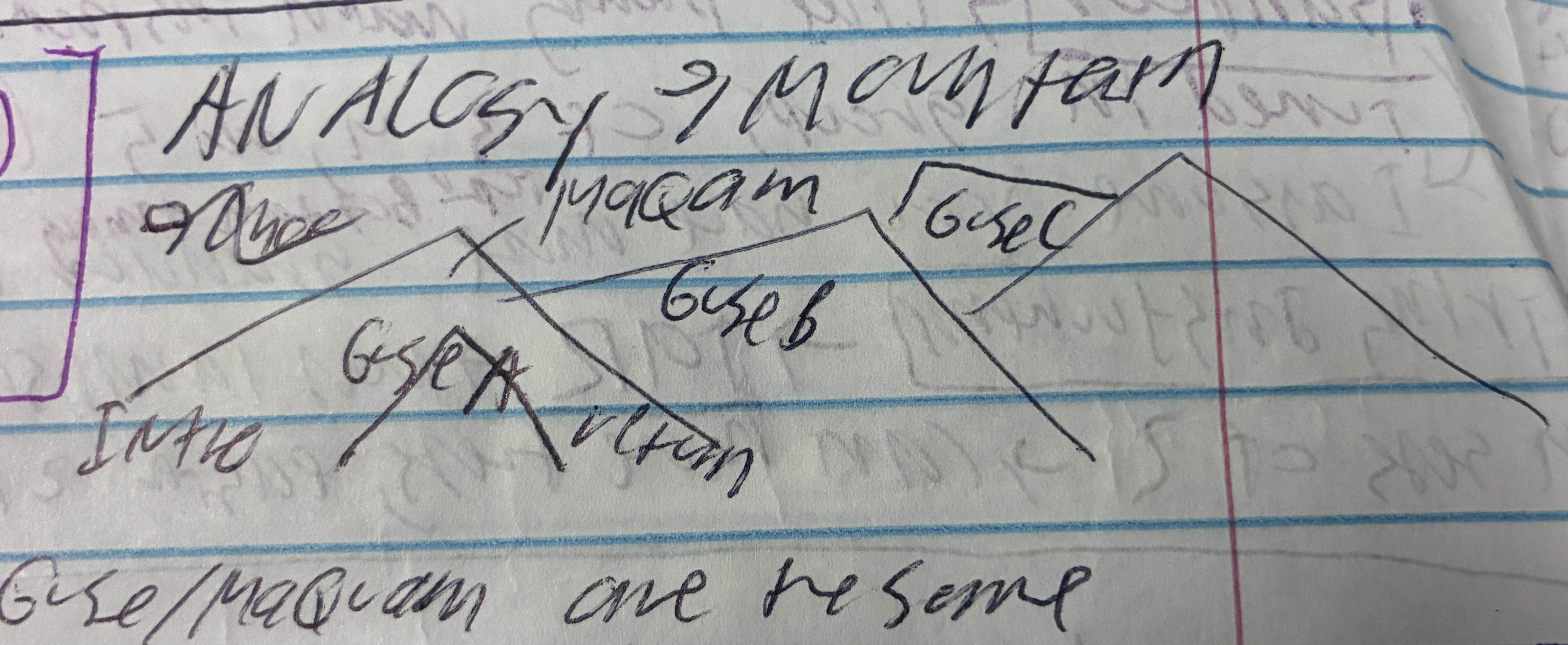
The analogy used to explain dastgahs to us was that of a mountain range. Basically there are three aspects to a dastgah, the intro (base), body, and conclusion. But you can jump up and down different mountain peaks depending on what guse/maqam you’re using. Thus I think this is what the speaker meant when they said that there are “rules for improv”, you’re either going up and down one mountain or jumping up to another or going back down to the base to end the song.
A better picture of a drawing I made to convey this is shown below. The sense I got was that one jumps between different sets of scales that go together basically, up and down the mountain range.
Thus for a mountain “station” one moves around tetrachords, but descends back to the “base” of the mountain or lower scale at the end.
Traditional Instruments
After the main music workshop we learned snippets of the history of traditional Iranian instruments/their development. Unfortunately here my notes become really fragmented because I ran out of paper and starter writing them in the margins of my economics notebook, so you will have to trust me on this.
This was the flyer for the event that I found online, the other people that spoke at the workshop were Hamed Erfani (composer-in-residence for the Oklahoma Chamber Symphony) and Hossein Khaleghian (oud/sitar)
Main Speaker
The main speaker of the event featured on the flyer also came up after the music explanation part of the workshop and gave a brief talk on the poet Rumi. From my notes I have that Rumi was an Islamic theologian until a vagabond asked him to come see the world with him, and thus Rumi learned about “deep listening” and the “whirling dance”. The speaker said that tradition says that the “music overtook him” and that’s how Rumi became a poet. Apologies to the speaker if I’m not doing that story justice, my notes are, as noted previously, very fragmentary.
Conclusion
That was a summary of my experience attending the Persian Classical Music Workshop at the Puterbaugh Lit Fest this April. It was honestly a really cool experience despite some of the music jargon maybe going over my head a bit. I learned about it through an extra credit opportunity in my World Literature to 1700 class, and thought it wouldn’t hurt to go check out. Thanks to the organizers of the Puterbaugh Lit Fest, my world literature professor, and all the speakers at this event for this experience. I hope that I’ve passed on just a bit of what I managed to learn about Persian music/poetry from this blog post, and if any errors exist they are mine and mine alone. As previously stated, I am a musical layman, who took rather fragmentary notes on this whole experience.
Hi everyone! Today I’ll be talking about the Japonisme movement and the 1867 Paris World’s Fair as my international topic of choice!
The 1867 Paris Exposition Universelle (World’s Fair) was the second World’s Fair hosted by the Second French Empire of Napoleon the Third and brought together roughly 50,000 exhibitors from approximately 32 countries and attracted roughly 11 million visitors over its 8-month duration. It was organized by economist Michel Chevalier and engineer Frédéric Le Play, and it sought to cover “everything everywhere”. Before the 1850s, Japan was extremely self-isolated, but with the opening of the ports, the country was opened to the West, and the West was opened to them. At the London World’s Fair in 1862, hundreds of Japanese decorative objects were presented and sold by the British Ambassador to Japan, Sir Rutherford Alcock. However, the 1867 Paris World’s Fair was the first in which Japan officially participated. At this fair, Japan was represented by a Japanese house and in the Pavillon de Satsuma in the Parc des Nations in the Champ-de-Mars around the Palais de l’Industrie. The introduction of Japanese art during this period led to a movement known as Japonisme.
The term Japonisme was coined by a French writer and art collector, Philippe Burty, in 1872; he used the word to describe “a new field of study of artistic, historic, and ethnographic borrowings from the arts of Japan”. It was a fascination that was not strictly limited to France either; it was widespread across America, the Netherlands, Great Britain, and Germany (where it was called Japanismus). Followers of this movement were particularly enticed by ukiyo-e prints, meaning “pictures of the floating world.” This school of art recorded the life, fashions, and entertainments of the Japanese urban and affluent people in the 17th through early 19th centuries. These prints depicted a world that the West had never known due to the intense isolation of the Tokugawa shoguns (1603-1867), who captured the imagination and admiration of Westerners.
Works cited
Brunet, François, and Jessica Talley. “Exhibiting the West at the Paris Exposition of 1867: Towards a New American Aesthetic Identity?” Transatlantica 2 (2017): 1-26. https://doi.org/10.4000/transatlantica.11280. Demeulenaere-Douyère, Christiane. “Japan at the World’s Fairs: A Reflection.” Journal of Japonisme 5 (2020): 129-151. https://doi.org/10.1163/24054992-00052P01. Lambourne, Lionel. Japonisme: Cultural Crossings between Japan and the West. Phaidon Press Limited (2005).
Hi everyone! In this post, I will be talking about my time at the Eve of Nations gala hosted by the IAC (International Advisory Committee), which took place on April 10th! I luckily got to go with my boyfriend this year since he could not attend with me last year. The theme for this year was Kairos, and I interpreted that to mean stars, but sadly, I did not own anything formal that had stars on it. This was such a fun event, and my boyfriend and I made a whole evening out of it!
We got to the event not too soon after it had started because I took a little too long getting ready, and luckily, there were still enough seats! When we were allowed to get food, we quickly grabbed a couple of things to snack on and something to drink, but nothing too crazy since we planned on getting dinner afterward. A friend of mine named Ajwad was there as well, and he sat next to us, and we got to catch up a bit, which was great considering he spent all of last semester at Arezzo. We watched a few of the performances, including the one by the Latin Dance club, which was amazing, and then we sadly had to leave to go to dinner with my boyfriend’s grandparents at Charleston’s here in Norman. Overall, just like last year, I had an amazing time and thoroughly enjoyed my evening and can not wait to go to next year’s Eve of Nations with the IAC!
Hi everyone! As many of you know or could have guessed, I am a member of OU Cousins! OU Cousins is a student organization that pairs international students with OU students, allowing them to form friendships and connect with others. I’ve been a part of this organization since Freshman year and have loved my time with them!
My first year, I went to their game nights, bingo, and other activities, but decided not to match with anyone since it was my first year on campus and I was feeling overwhelmed. However, this year felt like the right time, so I attended the Fall match party! I had so much fun and wound up matching with a girl named Iris Winters, who is a meteorology student from the University of Redding in England. We hit it off right away, and we’ve been going to events and hanging out together all year long. We even went to the OU Cousins end-of-the-year picnic together. She’s leaving in late May, and I’m really sad to see her go, but we do plan to keep in touch and hopefully visit her someday!
Next year, I will continue my membership with OU Cousins and plan to match with another student in the fall since I had such a great experience this year with my OU Cousin. I also hope to attend more events with OU Cousins next year, particularly in the Spring, than I did this semester due to the number of hours I was taking (22 credit hours) and my job.
This year, I honestly wasn’t sure what student organization to join. I really enjoyed my time in OU Cousins last year, but I wasn’t able to attend any of the matching events, and so I figured it was a good opportunity to try something new. I decided to learn more about the Honor’s Cultural Council, an organization within the Honor’s College.
The mission of the Honor’s Cultural Council is to create a welcoming community within the Honor’s College and promote cultural awareness. They host a lot of events, including speaker panels, movie nights, and other parties like Valentine’s Day festivities. By far their most famous event is the International Food Night. This year, over 150 people and multiple student organizations attended and multiple student organizations. Most of the attendees were freshmen, but a fair amount of international upperclassmen attended as well.
One of my friends inspired me to join the organization. When asked about her reasoning for joining, she explained that the club was so active that she knew it was a great way to be involved. She also mentioned something that I thought was really great–interacting with people different than her. That really is the whole point of college isn’t it? You come to a new place and are surrounded by so many people, all there to learn and grow. This makes it a prime environment for gaining new experiences and making new friends.
Organizations like the Honors Cultural Council inspire students to gather together and share their traditions, culture, and experiences. By highlighting differences through sharing cultural experiences, they bridge gaps. I can’t wait to get more involved with this organization during the rest of my time here.
A Fascinating Glimpse Into International Economics
This past semester I had the privilege of attending an event held by ISSA, titled appropriately enough, “The End of Exorbitant Privilege: Changing Appetites in the Treasury Market and the Repricing of Hegemony” It was a really fascinating look into the international credit rating system/debt market through the lens of economics, which I appreciated being an econ major myself. Thus I thought I would summarize some of the key points/add some reflections in this post. Credit where credit is due to the ISSA team for the thumbnail on this post as well, the flyer was so well produced I couldn’t resist.
The World of U.S Privilege
Summary/Key Points
The U.S has run a deficit w/their national debt pretty much every year since the 70s
As counterintuitive as this seems, the U.S gained a lot of power from doing this. Running a deficit allowed us to become a “safe asset” in the global treasury market. What this means is that our debt was pretty valuable since we’ve never defaulted on it
Advantages to being the Safest Treasury Asset
The U.S got to borrow cheap
We could run deficits without crises —-> No one else (except Japan) can do this without dire consequences
Allows the U.S to project international power
Why Hold U.S Treasuries?
They were safe, very liquid, and convenient. Regarded as “absolutely safe”, despite their low yields, which I am told countries love when they are building their international portfolio
“Mars Factor”
Also 50-60% of U.S assets were bought by U.S military allies, the deal was we protect them and they soak up our debt
The End of That World/ Why the U.S is Losing that Privilege
2022 Watershed – Russia’s Invasion of Ukraine
My understanding of how asset freezes work is that when the U.S sells people treasuries they maintain the ability to freeze them at any time. Previously, asset freezes were only used against small countries, but in 2022 with Russia’s invasion of Ukraine, we saw asset freezes being used by the U.S against Russia, on a scale larger than anyone had ever seen before. This introduced the idea of “custodial risk” when buying U.S treasuries. If you’re a country that might end up opposed to the U.S buying treasuries could be a bad move because you leave yourself open to sanctions/asset freezes.
Increasing U.S Debt to GDP Ratio
Our national debt is out of control and it is starting to also affect our international credit rating, which doesn’t help things on top of the new “custodial risk” to buying U.S treasuries.
“The U.S spends 970 billion dollars just to on the interest for previous debt, not even including the debt itself. The defense budget, famously huge, is sitting at 900 billion.”
Paraphrase of ISSA’s presentation based on my notes
Signs of the U.S Losing this Market Dominance
The U.S has been downgraded by several international credit rating organizations. For names of these credit agencies, S&P, Fitch, and Moody’s specifically have downgraded the U.S, spanning from 2011-2025. For an idea of the type of downgrade, S&P moved the U.S from AAA to AA+, which is still good, just not where the U.S probably needs to be to continue tanking its increasing national debt with no ill effects.
Optimistic Caveats
Whether you think that the end of the U.S’s economic hegemony is a good or bad thing, the fact remains that it will happen slowly. These are just the warning signs. The U.S still does have a lot of institutional momentum. Given the dominance of the dollar in the global economy, it is a lot harder to pivot to things like gold or crypto than one might think, and those come with their own problems.
Credits/Attributions
Shoutout to whoever at ISSA designed the flyer for this event, used as a thumbnail for this post
Credit to Alibek Chekirov and Aiden Clarbour for putting together this presentation
Okay, something that really shocked me when I arrived to Scotland was the grocery store experience. The first couple of weeks were extremely tough because I didn’t know where any stores were or how to work the buses here. But now at the end of my semester, I feel confident enough to say that I know how to grocery shop here.
I’m currently in Aberdeen, Scotland and my semester is almost at a close. This post is officially dedicated to the grocery store chaos that I’ve experienced while being a student here. I’ll talk about the stores that I visited as well as anything else interesting I noticed while shopping here.
One of the first things that I noticed when shopping for groceries here is that it’s not called “grocery shopping”. It’s called “food shopping”. Before I met anyone from the UK I would overhear conversations between friends on the bus and they’d always say they needed to “food shop this weekend”. I still call it grocery shopping, but “food shop” really accentuates the idea that almost everything that’s called something different here in the UK is just a more literal version of what we call it in the US. (Elevator = lift, parking lot = car park, etc.)
But besides that, the stores actually look and run very similarly to those in the US. A couple of the different things I can think of are:
Paying for shopping bags (most people bring their own)
The shopping carts are small and you pull them (only once did I see a real shopping cart)
The eggs aren’t refrigerated and they’re in the baking isles most of the time
There are security guards at a lot of stores (I’ve seen some in the US before but not nearly as many)
Cash register = till
Scan and go is popular
The food goes bad quickly, so people have to shop every week or more than once a week (busy stores)
Those are the top things I can think of that would differ from stores in the US. I knew some of these before getting here, but some like the shopping carts shocked me a little bit. Additionally, having to go grocery shopping multiple times a week was a change I had to get used to.
My all time favorite grocery store that I visited here was Tesco. Tesco has stores that are big and small (convenience stores) and they’re everywhere across the UK. Where I live, there’s not a big Tesco nearby, so I get really excited when we’re visiting a new city and they have a one we can visit. Tesco can be equated to a Walmart in the US. Big Tescos have spots for a pharmacy, a cafe, clothing sections, and food at a really good price. My only critique for Tesco is that you will feel very left out if you don’t have a club card since that’s how you get things discounted.
My second favorite store is Lidl. There are some Lidls across the US east coast, but I had never seen one until I got here. Lidl is smaller than Tesco, but operates all across Europe and is lots of people’s go-to for cheap, quality groceries. Lidl holds a lot of their own branded items, so sometimes it can be hard to find exact things that you’re looking for, but overall it’s great. We have one nearby the student residence at the University, and it’s convenient for shopping each week. The bakery is the best part and the cinnamon bun is my all time favorite grocery store bakery item.
I’ve also visited ASDA, Morrisons, Sainsburys, M&S Food, and Co-op. Morrisons and ASDA are also similar to Walmart, but they don’t always come with cafes and pharmacies. Sainsburys is convenient if you’re in the city centre, but it’s not as cheap as Lidl or Tesco. M&S Food and Co-op are by far the most expensive, but the Co-op is good for a quick snack.
Visiting grocery stores in a new country (in my opinion), is one of the best ways to get a glimpse into the culture. In the UK, I’ve been able to travel to so many stores we don’t have in the US and it’s really been fun to look at the cultural differences through food. If you’re ever out of the country I would definitely recommend taking a quick trip to the nearest supermarket to see what they have!
What does being a tourist in your own city look like? Well for me, this question takes on a whole new meaning while studying abroad.
I’m studying at the University of Aberdeen and finally at the very end of my semester I’ve decided to set out a day for “tourism” in the city. It feels wrong to say that considering I still feel like a tourist, but until today, I’d never really explored what Aberdeen has to offer.
For starters, Aberdeen is a nice city. I went to three museums, two botanical gardens, and walked around my campus. That alone took an entire day and got me close to twenty thousand steps. I had a really good time getting to know the city from a new perspective, and I actually got to see parts of the city that I haven’t even driven past yet. There’s two rivers that Aberdeen falls between; the River of Dee and the River of Don. Because I was able to see both rivers, I basically went from one side to the other.
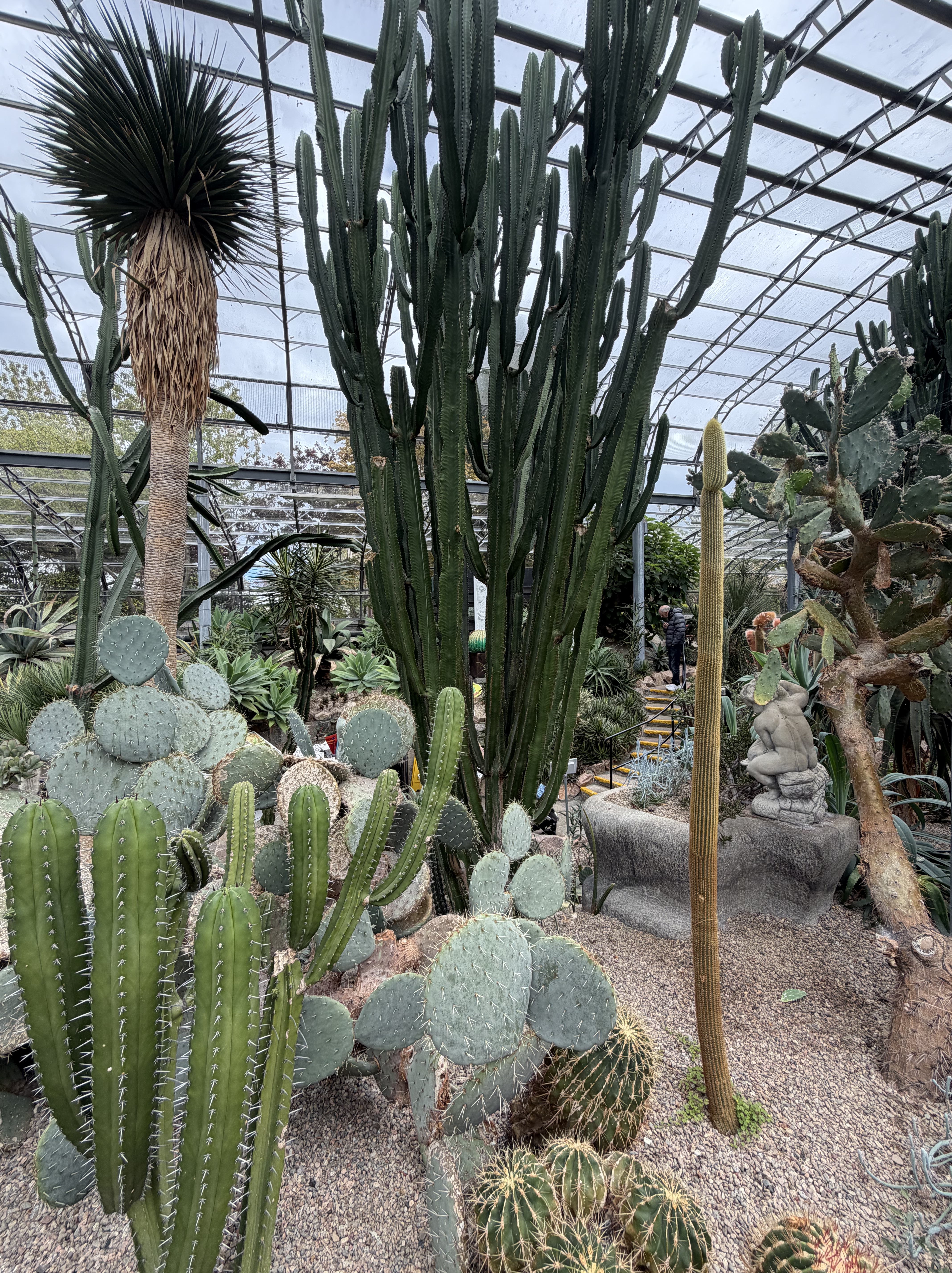
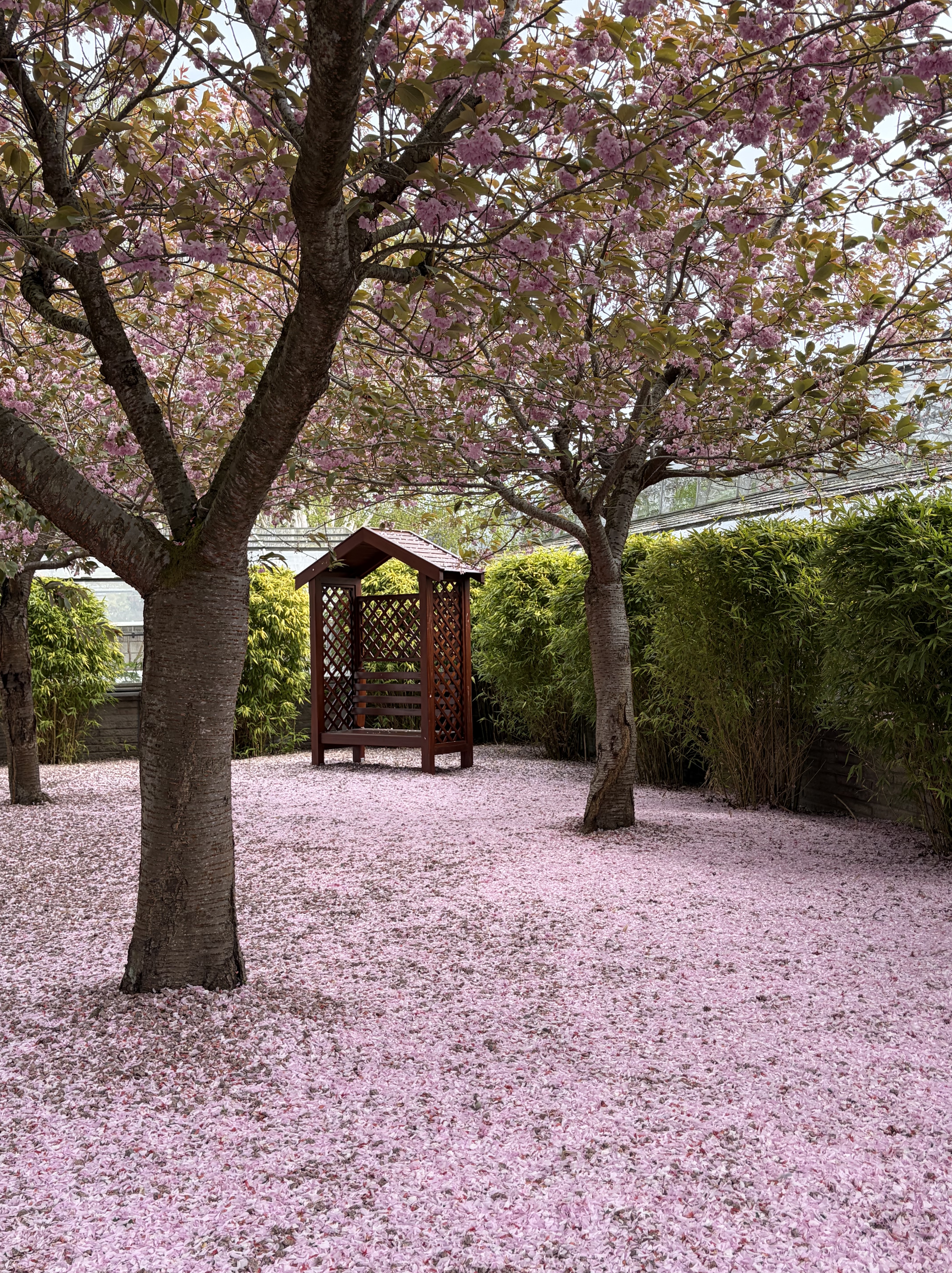
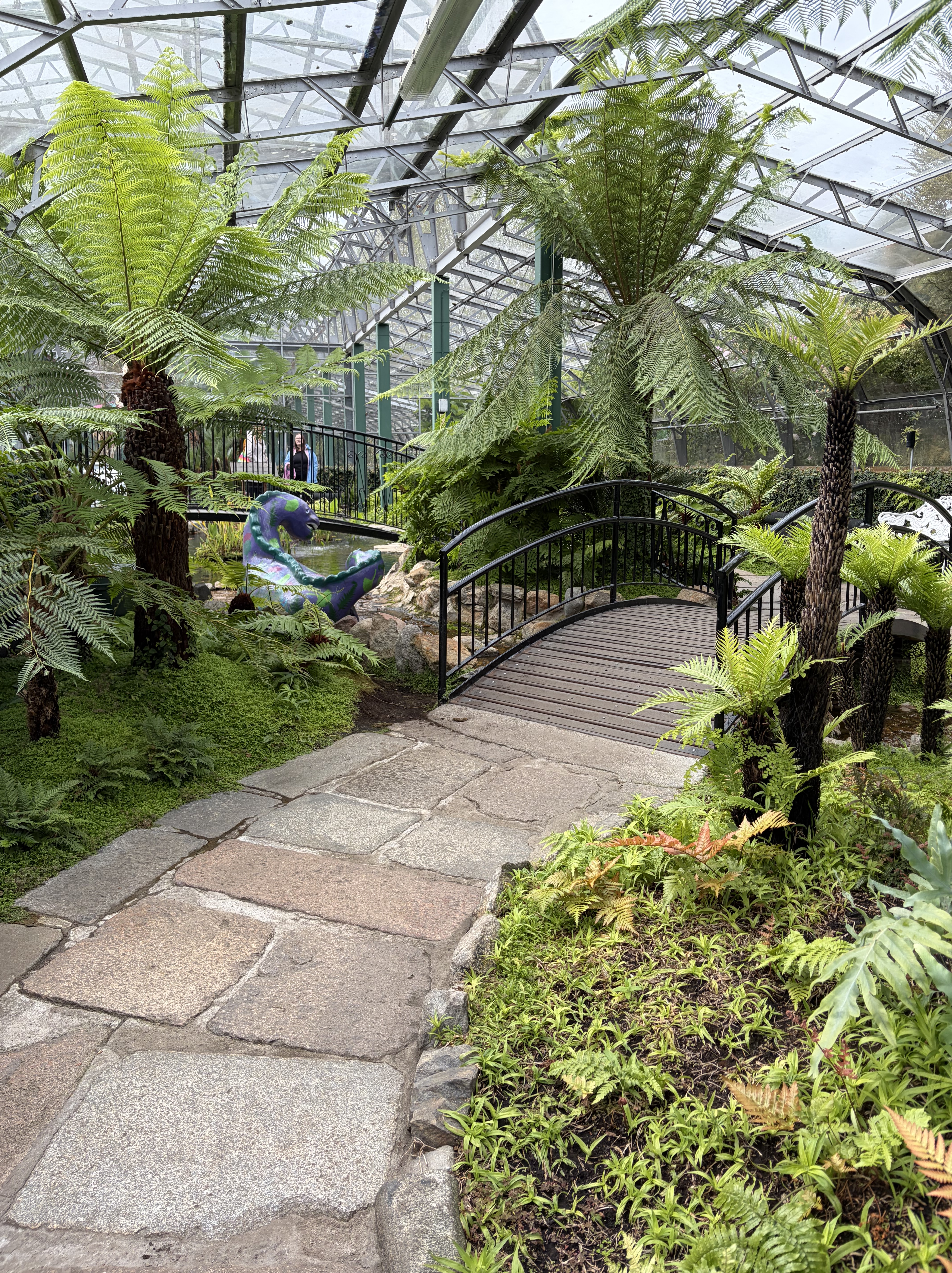
My favorite thing that we did was go to the Botanical Gardens. Both were so beautiful and it was so nice outside which made everything brighter. (Scotland’s usually pretty gray so this was a major win) The botanical gardens in the city centre were engulfed in a huge park and had different indoor greenhouse rooms for different plants. I saw a desert room, a temperate rainforest room, and a Japanese garden.
The botanical gardens on campus were a gateway to get to the University’s Zoology museum, which was also very nice and had a lot of exhibits on display.
The botanical gardens were my favorite, and while I was visiting them I did begin to think about how often people overlook the places they live in. In Oklahoma I know this is very true. People tend to say “don’t visit here there’s nothing to do” or “I hate it here” and I do understand that sometimes there really is nothing to do, but oftentimes people overlook certain things that tourists would see. I’m not saying every place is packed with things to do, but almost every place has something unique about it that tourists and travelers can remember it by.
It’s easy to get into the mindset that the city or town you live in is boring, but sometimes taking an outside look can give you a new perspective on your own culture. For me in Aberdeen, going to so many museums and walking around the city centre helped give me a refreshed look at where I’ve been living this semester. And because I’m not Scottish, I am an actual tourist here. But when I get back to Oklahoma I’m going to make it my best effort to seek out the things that I think someone who hasn’t been there before would consider my culture.
Hey, it’s me, I‘m back again with another highly critical negative post regarding language learning standards!!!
Yesterday I attended the German Comics Microcourse final project presentations, and wow were those some of the longest minutes of my life!!
The goal of this event was for each student who had been enrolled in the Comics Microcourse with Frau Preuss (a 1 credit hour upper division GERM course) to present their poster, which was a comic, to the group. Ideally, this would be reading the comic to us and explaining the motivation behind it, the creative process, and maybe some concepts they learned from the class.
Let me start with the good things:
There were several students whose comics were visually appealing, or had interesting premises. The use of German vocabulary throughout generally was fitting and reasonable. The stories for the most part made sense. Several were funny or meaningful.
Now let me continue on with the bad things:
Most everyone (excepting maybe 2 students) enrolled in the microcourse was at too low of a German proficiency to adequately explain their poster, and in some cases could not even read, pronounce, or understand their own text they had put in their comic.
It was apparent in some students’ reading – intonation and emphasis, that they had absolutely no idea what the words meant as they said them aloud.
There were several students from first semester German courses in the room, so Frau Preuss kept interrupting to translate the broken German into English. Again, these are comics, and in my opinion we could have done without the constant translation, as the plot of the comics is really self explanatory.
There were some students who had prepared a written-out speech to give with their comic presentation, but set it aside at the last minute and decided to “wing it”. This was a mistake that lead to incredibly inefficient presentations that were painful to sit through.
Super nitpicky things: several key grammatical phrases were just wrong every time, even for the higher level students.
In my opinion, our standards for presentations have dropped to an embarrassing low. If this is the final project for an upper-division course, it should be engaging and be CLEAR THAT YOU PREPARED FOR IT.
Truly the worst thing is that the final presentation of the day was a capstone presentation over the German constitutions, and this was actually delivered very well, but had to be rushed due to the delays and poor presentation efficiency of the previous microcourse presentations. I personally would have preferred to hear more from Karl about the Constitutions and less from the Microcoursers.
I vow personally to crush everyone else in my classes in presentations from this day forth and compensate for the terror that has been inflicted upon me this semester.


 Global Engagement Fellowship