Why Most Mexicans Don’t Celebrate Cinco de Mayo

In the United States there are many people, especially non-Mexican people, who celebrate Cinco de Mayo by going to their local Mexican restaurants and ordering food and so on. The reality is, in Mexico, Cinco de Mayo isn’t widely celebrated. 

Let’s clear up some misconceptions. Cinco de Mayo is not Mexico’s independence day. It isn’t the fourth of July equivalent like some people believe. It’s not even a national holiday. 

So, what exactly is it? 

Cinco de Mayo celebrates the Mexican army’s victory over French imperial forces at the Battle of Puebla in 1862 during the Franco-Mexican War. 

In Mexico, Cinco de Mayo is viewed more as a state holiday, celebrated primarily in the state of Puebla. Although, other parts of Mexico celebrate as well. The holiday is often celebrated with military parades and scene reenactments. 

However, for a majority of the population, May 5th is just another work day. Since it is not a national holiday, banks, offices and stores remain open. 

While Cinco de Mayo is not widely celebrated in Mexico, it has become incredibly popular abroad. In the U.S. the holiday is seen as a celebration of Mexican culture and heritage. Celebrations often involve music, food and more. 

Mexico’s Independence day is actually on September 16th not May 5th. It marks the beginning of the Mexican War of Independence. On this day in 1810,  Miguel Hidalgo y Costilla called for a revolt against the Spanish empire. Every year on the night of September 15, the Mexican president will reenact the Grito, yelling “¡Viva México!” 

Hopefully you have a clearer idea of Mexico’s independence day and Cinco de Mayo!

Thanks for reading!

Yailin

OU Cousins

This Spring was my fourth semester as a member of the international club, OU Cousins. As a freshman I became “cousins” with a student from South Korea. I got to know her and her culture and we became good friends. In fact, this past summer I went to South Korea to study abroad for a month. While I was there I got to see my friend twice! Together we explored Seoul and tried a lot of delicious foods.

This year I wasn’t too worried about getting an official cousin. I decided I would try to make more friends through the club. I went to the match party last semester with two friends, both of whom are also from the United States. Unfortunately, I wasn’t able to go to the match party this semester because of class I had. However, I was able to make a few friends last semester that I have kept in touch with over the school year. 

I made a friend from Japan who was, coincidentally, in my friend’s class last semester. I’ve gotten to learn more about Japanese culture through him and he’s helped some friends and I by explaining some of the grammar patterns we’ve learned in class. He’s really nice and does a good job at explaining things. He’s definitely the reason we all did really well on our Japanese finals last semester! A few of my friends (from my Japanese class) actually had the opportunity to go to Dallas and bring him with us. It was a really fun time and we even went to a photobooth to take pictures! Trying to fit everyone into the frame was a bit of a challenge though. 

My other friend/ unofficial cousin (we never actually filled out the form, both of us forgot) is from South Korea. We were able to go to OU Cousingiving together last semester and it was really fun. He’s a very easy-going person who is always down to do anything. At one point, I took him to a Korean restaurant to see if he would like it, in comparison to the food in Korea, and he did. 

Overall I’m pretty happy to be part of OU Cousins, I think it’s a lot of fun and you can make a lot of really great friends out of it.

Thanks for reading!

Yailin

おにぎり- Onigiri Workshop

In March, the Japanese department hosted an onigiri workshop open to any student taking a Japanese language course. We made and ate onigiri (おにぎり)! 

Onigiri is believed to have originated in the Yayoi period, approximately 2000 years ago. Originally, the rice was shaped into balls and served as easily transportable snacks for travelers and soldiers. During the Edo period (1603-1867), people began wrapping the onigiri in seaweed, a feature commonly recognized in the onigiri today. During this time period the triangle shaped onigiri we’re familiar with now became popular. 

In the workshop we made furikake onigiri which is made by mixing rice with Japanese seasoning called furikake. There was also rice mixed with red shiso or perilla leaves. Both were very good. The rice was already made when we arrived. All we had to do was shape the rice into a triangular shape and wrap it in seaweed. It sounds simple enough but getting it perfect can be a little hard. It was still very fun! 

Onigiri is often made with a variety of fillings including salmon, umeboshi and tuna. The onigiri often sold in convenience stores in Japan usually have filling in them. My favorite filling is tuna mayo. I probably had at least one onigiri every day when I was in Japan. I had the chance to try onigiri from convenience stores and restaurants. Honestly, both were incredibly delicious. It really is the perfect snack: easy to carry around, eat and it’s good.

The workshop was really fun! Now I’m really craving onigiri!

Thanks for reading!

Yailin Serrano

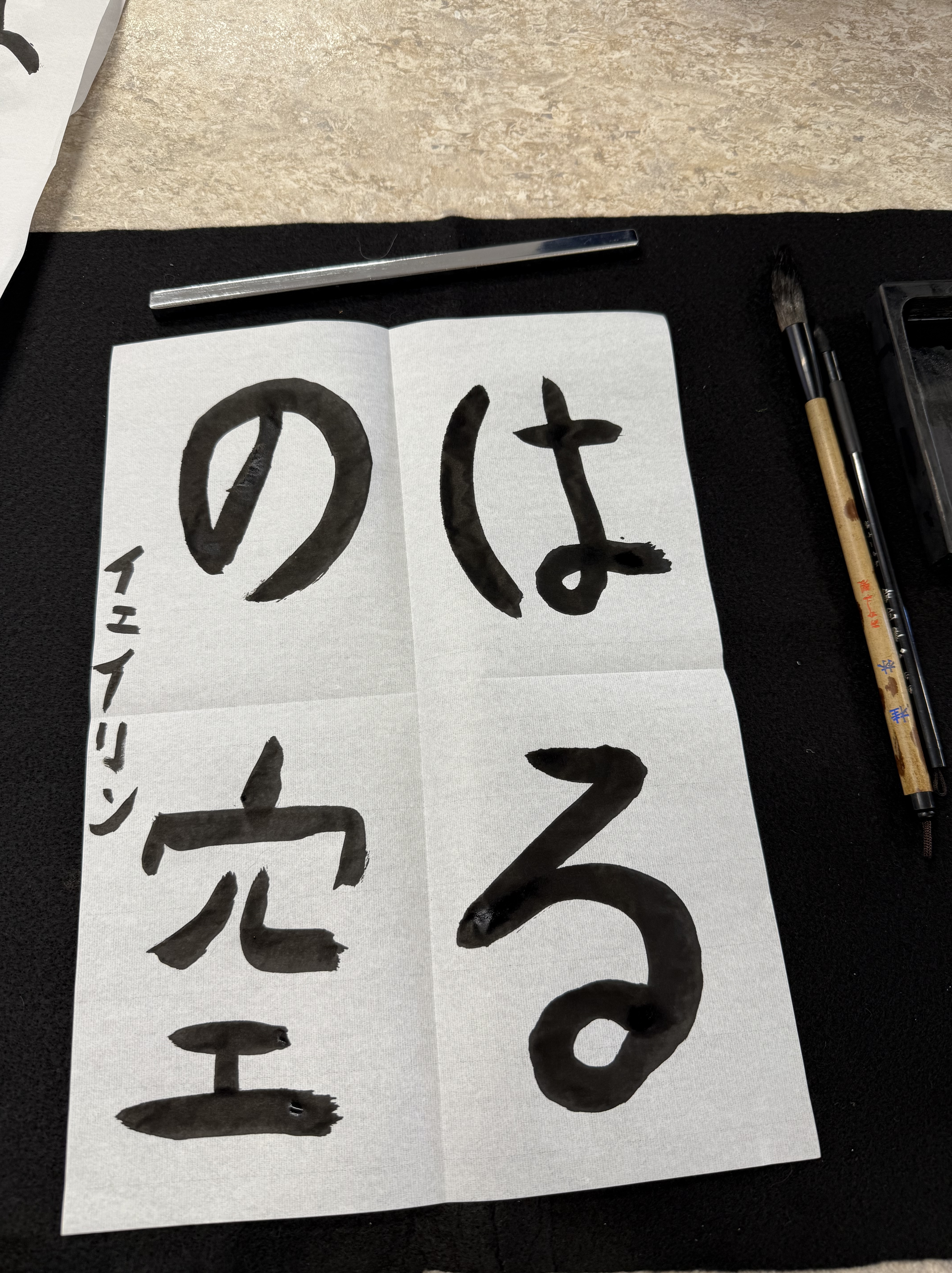
書道 – Calligraphy Workshop

In February, I had the opportunity to attend a calligraphy workshop hosted by the Japanese department. This event was open to any student taking a Japanese language course. Coincidentally, this event came at the perfect time. This semester the topic of one of the chapters my class went over was Japanese culture and customs. 

Calligraphy or 書道 (Shodo) is an art that has been used and adapted for centuries in Japan starting in the 6th century. It has Chinese origins and has developed into a unique art form that is practiced across the country. The name 書道 consists of two kanjis (Japanese characters): 書 meaning writing or to write and 道 meaning way or street. Literally translating to “way of writing.” 

When practicing calligraphy, four things are used: a brush, ink, inkstone and paper. Brushes can come in all shapes and sizes. There are also several calligraphy styles including Tensho (ancient seal script) and so on. In the workshop we didn’t go over any particular style. We were just encouraged to start. 

I will admit, it was very challenging. Calligraphy can take years to master and even then you continue to learn over the course of your life. That’s why it’s called the way (or path) of writing! The hardest part for me was applying the right amount of pressure to the brush to get the stroke correct. My finished product was not the best but it was definitely legible.

The characters we wrote were はるの空 (haru no sora), meaning spring sky. We also wrote our names, in katakana, in smaller writing on the left. Katakana is the alphabet usually used for foreign words. 

I’m so glad I had the opportunity to attend this event. It was a challenge but it was also really fun! I’d love to do it again and I recommend trying it at least once!

Thanks for reading! 

Yailin Serrano