Hey, it’s me, I‘m back again with another highly critical negative post regarding language learning standards!!!
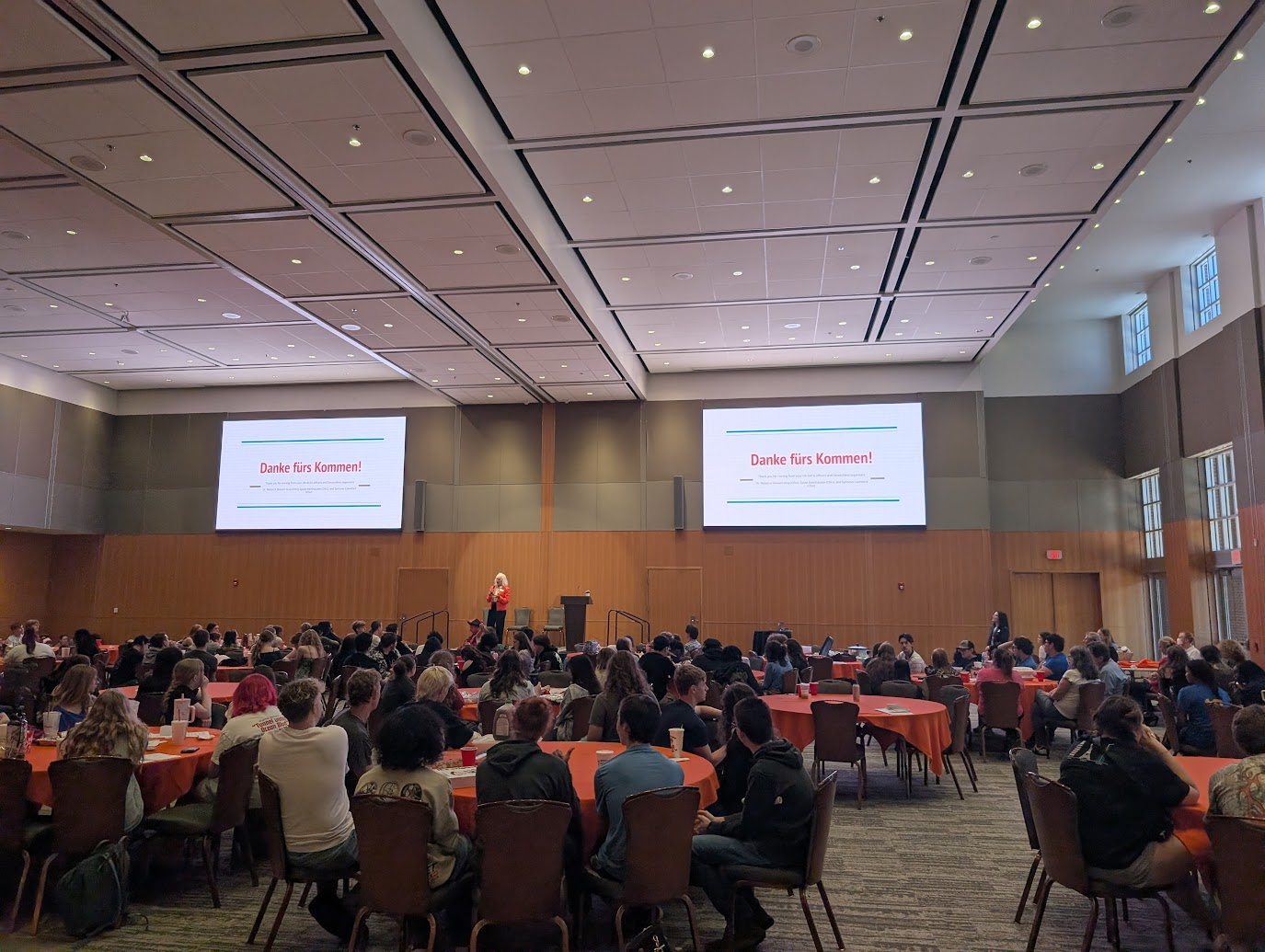
Yesterday I attended the German Comics Microcourse final project presentations, and wow were those some of the longest minutes of my life!!
The goal of this event was for each student who had been enrolled in the Comics Microcourse with Frau Preuss (a 1 credit hour upper division GERM course) to present their poster, which was a comic, to the group. Ideally, this would be reading the comic to us and explaining the motivation behind it, the creative process, and maybe some concepts they learned from the class.
Let me start with the good things:
There were several students whose comics were visually appealing, or had interesting premises. The use of German vocabulary throughout generally was fitting and reasonable. The stories for the most part made sense. Several were funny or meaningful.
Now let me continue on with the bad things:
Most everyone (excepting maybe 2 students) enrolled in the microcourse was at too low of a German proficiency to adequately explain their poster, and in some cases could not even read, pronounce, or understand their own text they had put in their comic.
It was apparent in some students’ reading – intonation and emphasis, that they had absolutely no idea what the words meant as they said them aloud.
There were several students from first semester German courses in the room, so Frau Preuss kept interrupting to translate the broken German into English. Again, these are comics, and in my opinion we could have done without the constant translation, as the plot of the comics is really self explanatory.
There were some students who had prepared a written-out speech to give with their comic presentation, but set it aside at the last minute and decided to “wing it”. This was a mistake that lead to incredibly inefficient presentations that were painful to sit through.
Super nitpicky things: several key grammatical phrases were just wrong every time, even for the higher level students.
In my opinion, our standards for presentations have dropped to an embarrassing low. If this is the final project for an upper-division course, it should be engaging and be CLEAR THAT YOU PREPARED FOR IT.
Truly the worst thing is that the final presentation of the day was a capstone presentation over the German constitutions, and this was actually delivered very well, but had to be rushed due to the delays and poor presentation efficiency of the previous microcourse presentations. I personally would have preferred to hear more from Karl about the Constitutions and less from the Microcoursers.
I vow personally to crush everyone else in my classes in presentations from this day forth and compensate for the terror that has been inflicted upon me this semester.
This semester I continued with my role as the German tutor through the Academic Success Center, holding two two-hour tutoring sessions every week in Kaufman hall. Despite the fact that I know there are many students struggling to meet the expectations of a committed learner in beginning, intermediate, and advanced classes, the attendance at my tutoring was abysmal. I advertised to almost every class at the beginning of the semester, but I usually had only regulars, or someone who never came back. With returning students, I often felt like the effort was not being put in between sessions to see any real improvement. Having a language requirement for college is a key part of a well-rounded education, and being a part of the arts and sciences college and Modern Languages department adds to how connected I feel on campus, but for many students it seems too far out of their comfort zones. College is a place you have to grow, and you HAVE TO WORK FOR IT!!!!
If you are enrolled in a language class and struggling, try harder NOW before you’re 3 semesters deep and unable to string together a single sentence. We all learned how to speak to get here, and struggling to learn a language is an excellent exercise of empathy as a member of the global community.
I also attended a film screening from Frau Preuss and Stammtisch, for the first time! Not sure if I will go back again, but next year I will be living closer to Main Street so it is plausible!!
In other news, I won the German Club award again this year, and enjoyed the MLLL Banquet and Awards Ceremony. I will try to promote tutoring again next semester, and stay involved in German Club.
Another year, another Deutschfest! I carpooled with Lorren to the classic OnCue in OKC and then we drove with Dr. Bangor to OSU campus.
Deutschfest is an annual event hosted by the OU, OSU and UCO German departments which hosts high school German students from high schools around Oklahoma in a day long field trip. We provide lunch and opportunities for learning challenges and competitions. Students have the option to submit a piece of artwork or a baked good to be judged, or participate in music performance or poetry recitation competitions, which they prepare for ahead of time. The other challenges include vocabulary tests, listening comprehension, and grammar focused jeopardy.
This year I was the host of the “Draw What You Hear” station, and it was honestly lucky that I am as proficient in German as I am, because the pre-recorded tracks we were meant to play were nowhere to be found, so I just read the passages aloud. The task was to listen to each passage read aloud 3 times, and color in a worksheet or draw the scene described. There were 4 different rounds which varied in difficulty. Students at the easiest level had to fill out a family tree, and at the hardest had to draw a complicated scene of a vacation on a beach. I had fun, graded the drawings to award prizes, and got to present the awards.
During lunch we also were able to sample what was left of the baked goods, view the art, and chat with professors and high schoolers. They also had a scavenger hunt they could fill out to win a prize, which included asking volunteers from each school a fun fact about their university. As always, I had a lot of fun, and will be helping out again next year when it returns to UCO!
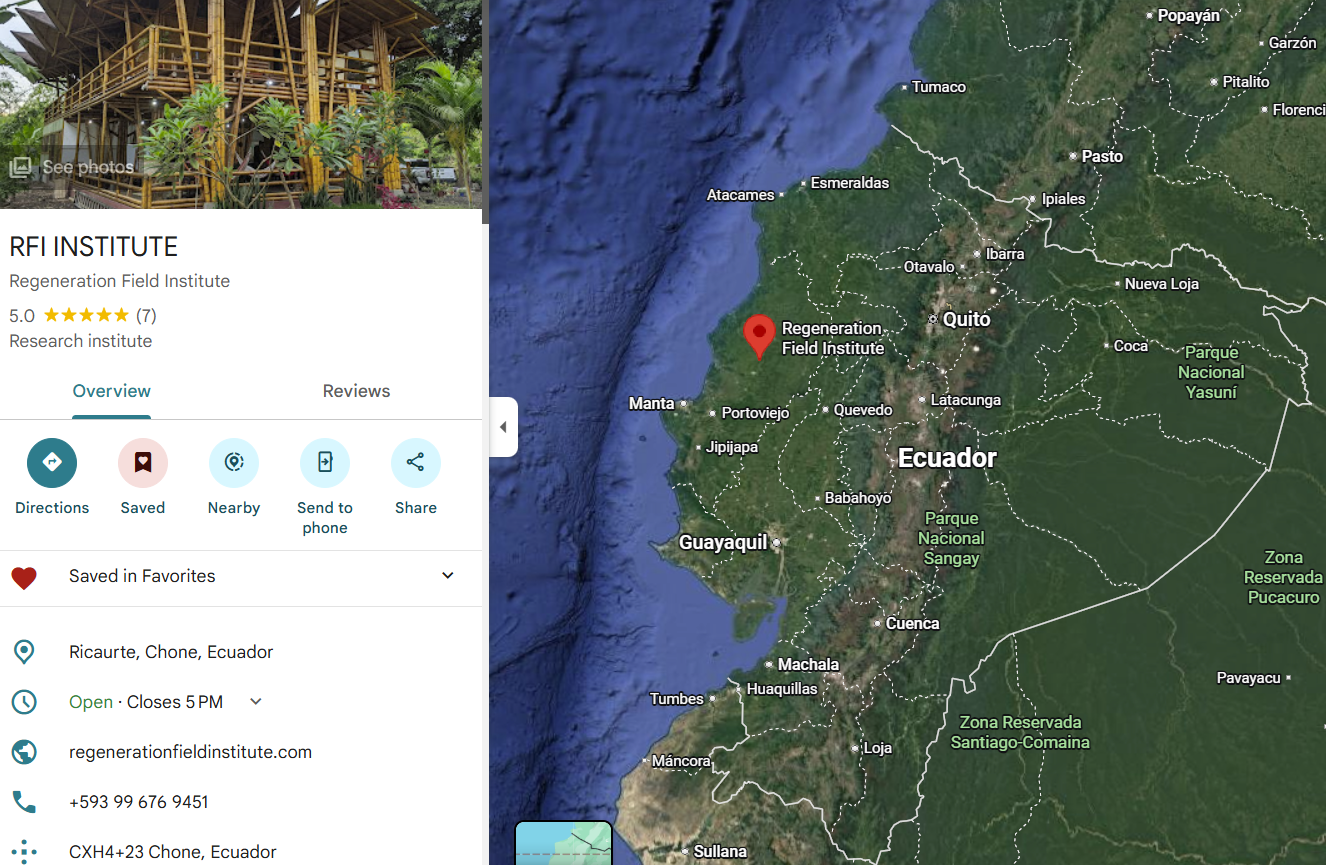
Sooners Without Borders is a Registered Student Organization active under the Gallogly College of Engineering at OU. I am the Vice President, and my friend Victoria Gilfillan restarted the club’s international service trip tradition this year, as we coordinated a trip to take 11 OU students to Chone, Ecuador.
Travel began January 7th, 2026, and all students arrived in the morning of January 8th at the Quito airport. For this program, the 11 OU students were joined by 12 UC Berkeley students, totaling 24 for our program. From the airport, it was an 8-hour bus ride to the RFI farm. The journey from the mountains of Quito down towards the coast consisted of fog, hairpin turns, and the discovery that bathrooms are BYOTP.
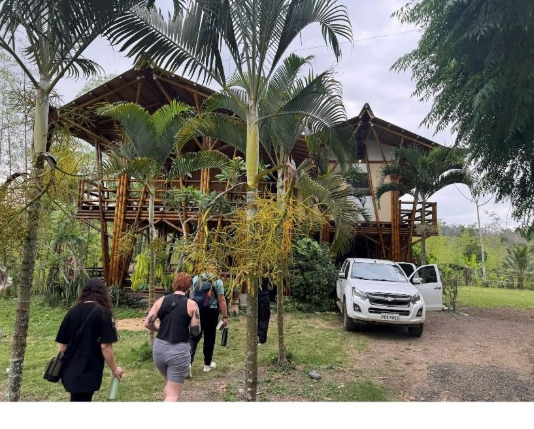
Students arriving at the RFI farm in Chone, Ecuador, on January 8th, 2026.
Upon reaching the farm, we chose bunks, were served dinner, and spent our first evening getting to know the UC Berkeley students and each other better. Our general schedule was a 7:00 am wake-up call, breakfast, morning work, lunch, afternoon lesson/lecture, dinner, showers, evening work/lesson, and quiet hours at 10:00 pm. Although this schedule was followed very loosely, we were up in the morning at 7 at the latest, and in bed by 10:30 at the earliest. Our 9-day trip was extremely full of activity, learning, and making new connections!
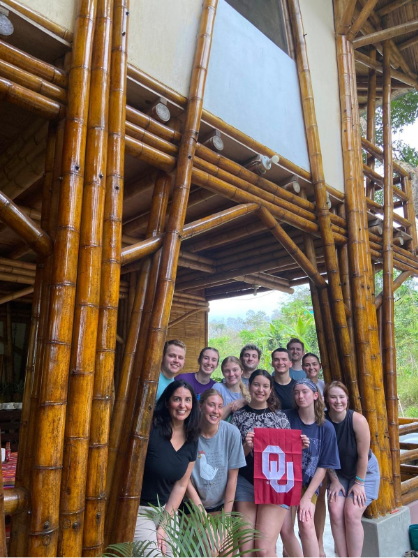
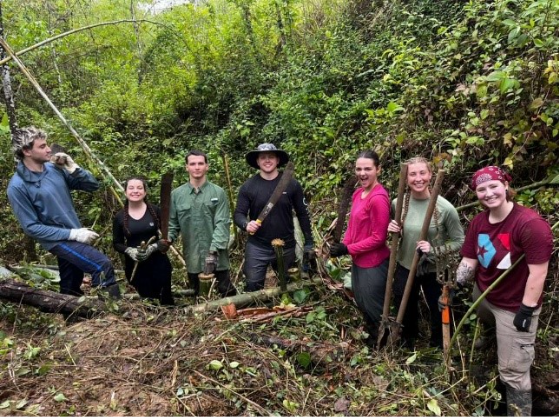
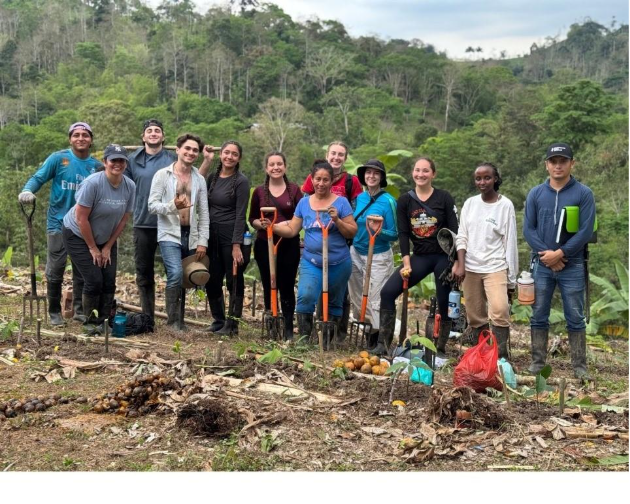
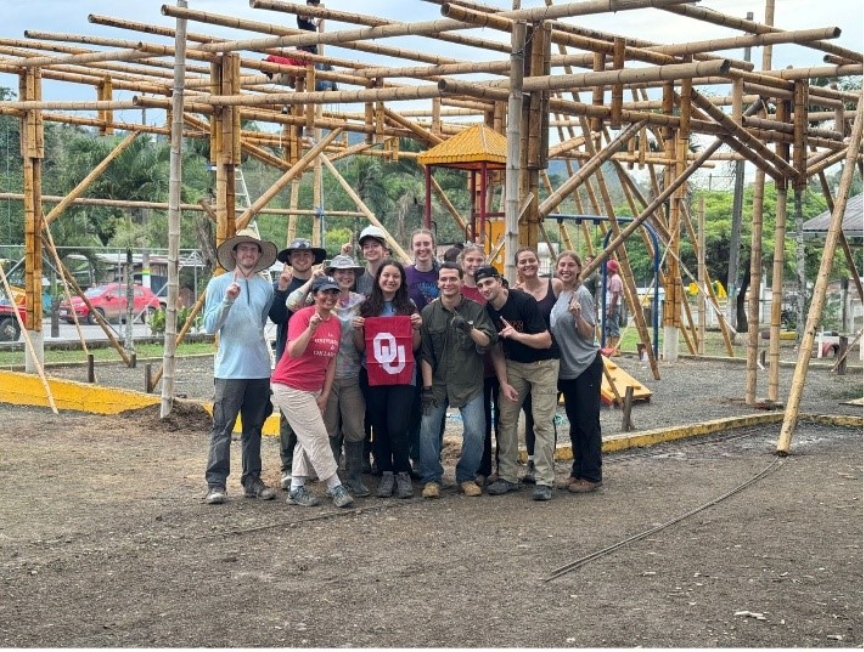
First group photo at the farm! From left back row: Trent Rogers, Audrey Hirchert-Walton, Victoria Gilfillan, Jaden Sloan, Chaz Hall, Travis Lloyd, Jimma Fuson. From Right front Row: RaCamie Bover, Julia Robbins, Izzy Harris, Ashlyn Olmsted, Lisa Morales.
On our first day, we got a tour of the farm and learned more about RFI’s mission. We then had the first of several bamboo lectures from Jorge Loor Ocampo. Jorge is an architect who works with RFI on bamboo projects and instructs programs like ours. During these lectures, we learned about the advantages and limitations of bamboo as a building material, how it is prepared and used in the best practices, especially in projects like ours, which gave us a better understanding of the structure we would be working on. We also had hands-on learning experiences in workshops on the farm, from carrying bamboo to shaping the characteristic “fish mouths” needed for joining bamboo in structures.
We also had the opportunity to learn about RFI’s syntropic agroforestry systems implemented on their own farm and other local farms. Upon touring the farm on the second day, we saw the rows of diverse plantings that are working to provide shade and biomass to restore rich jungle soil quality. At this point, our leaders separated us into three groups to work on various projects around the farm. The projects we worked on at the farm were “Bamboo Dams” and “Living Edges”.
The bamboo dams served to retain valuable topsoil and reduce sediment pollution during seasonal heavy rains. Bamboo was cut nearby on the farm, transported by us to the gully we were damming, hand-cut and hammered into place by rotations of groups. As the dams are biodegradable, the hope is that over time, the soil will build up behind each placed dam and reduce the dramatic slope in the area, providing more usable land.
Students working on the bamboo dams.
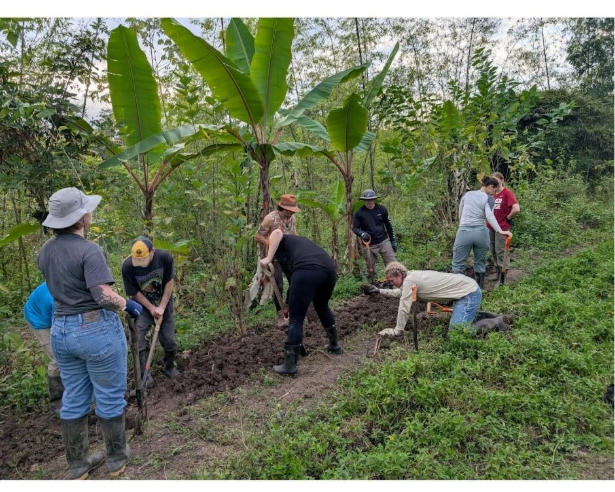
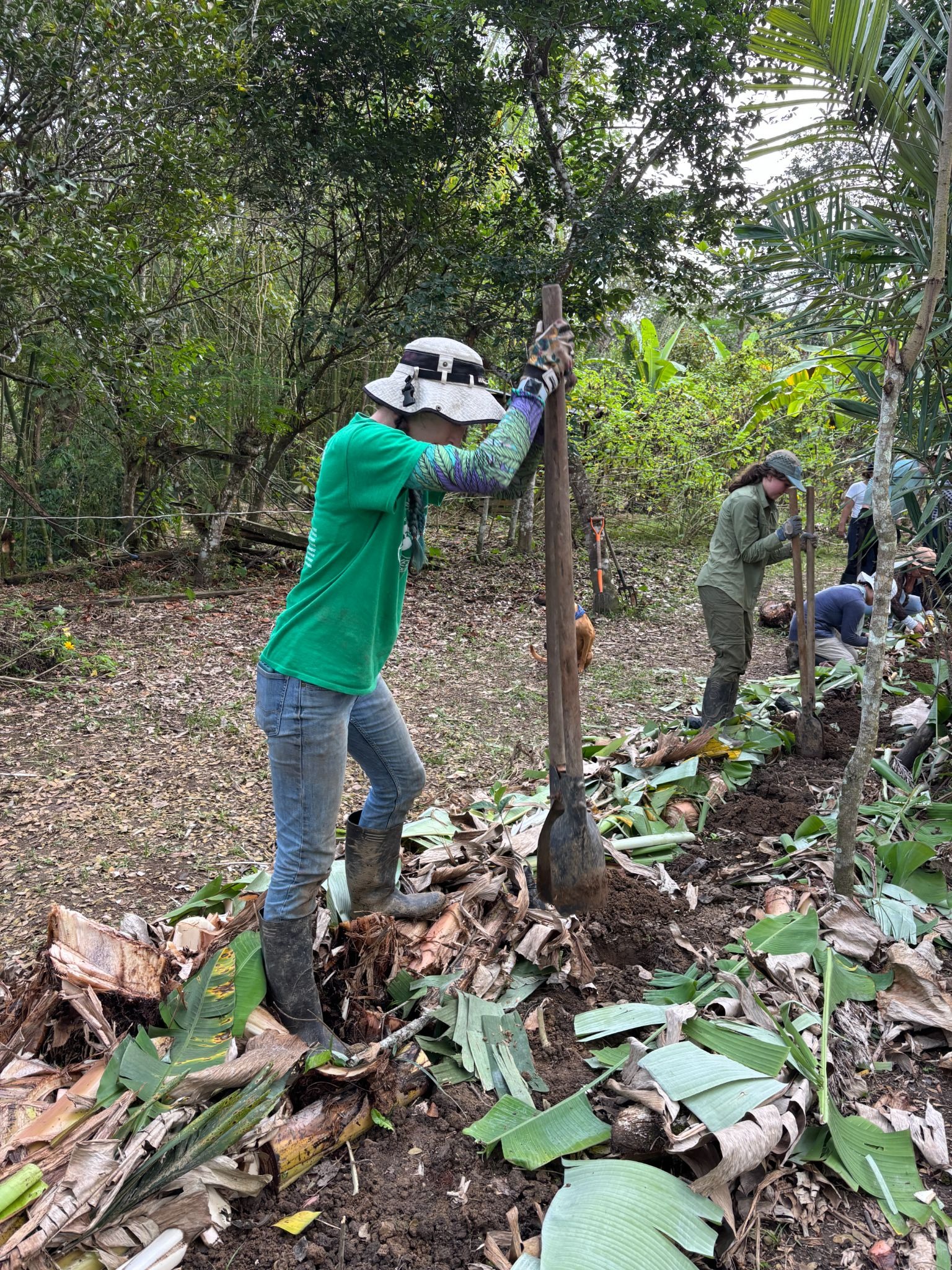
Living Edges is the project lining the pathways on the farm, encouraging so-called “bio-corridors” that can be a hub of biodiversity connecting different areas of the farm. We first had to work to loosen the soil, which we did using the strategy of “double digging”, the same method commonly used in the Peace Corps agriculture sector. Our club advisor, Mrs. Lisa, and RFI’s trip leader, Chris Galena, had both served in the Peace Corps in Paraguay and were well-practiced in the work. These plantings lining the pathways will help to spread native plant species throughout the farm and provide habitat for animal species, such as howler monkeys, to move with ease around the area.
Students double-digging for bio corridors.
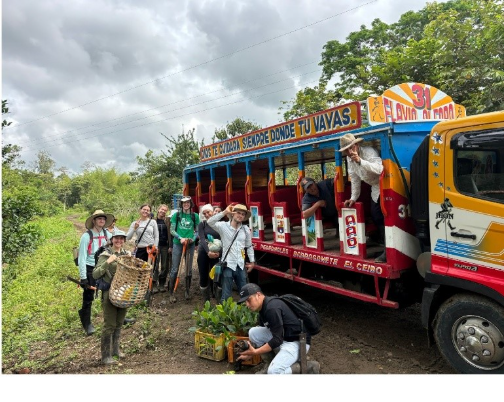
One of the most rewarding activities we participated in was the “mingas”, which brings together many community members to work on one farm for a concentrated period of work. The idea is “today for you, tomorrow for me”, and was a great opportunity to connect with the local farmers. We traveled in an open bus as close as possible to the job sites, but had to go on foot when the roads were not able to accommodate our large vehicle.
Students unloading the bus to begin work at their minga.Me, digging a hole to place seeds in
We transported heavy loads of plants, stakes, seeds, and tools to the sites and helped plant highly diverse rows of plants that would be the base for syntropic agroforestry systems on these farms. When we traveled to the mingas, we had “tongas” brought to us for lunch. Tongas are mixtures of rice, plantains, peanut butter, and chicken wrapped in a banana leaf for transport. This natural packaging allowed us to dispose of our leftovers right where we were sitting. It’s freeing knowing everything you consume can go right back to the land you stand on.
One group at a minga site, after loosening soil and planting the first section of the syntropic system.
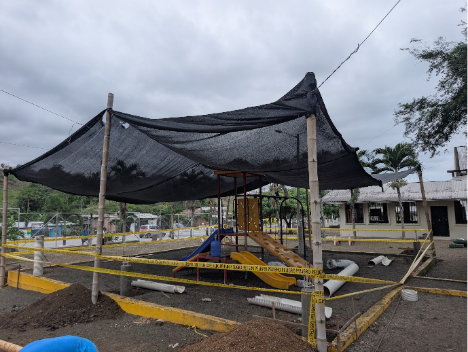
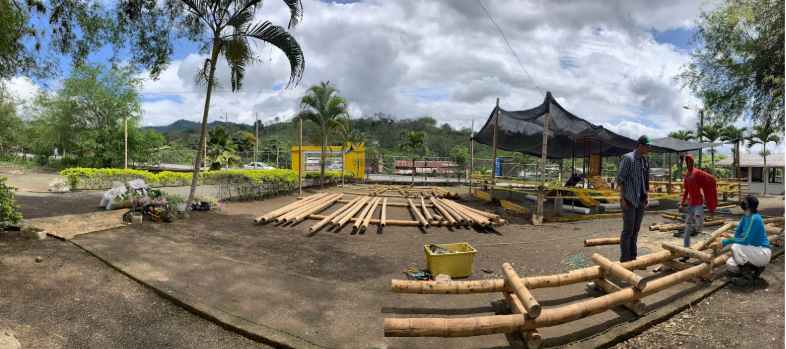
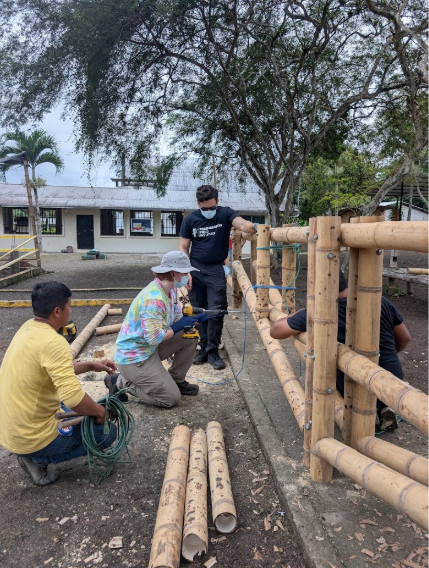
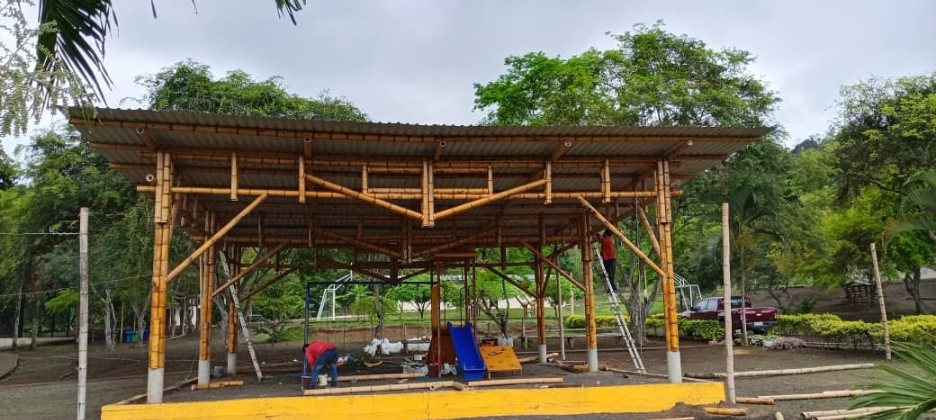
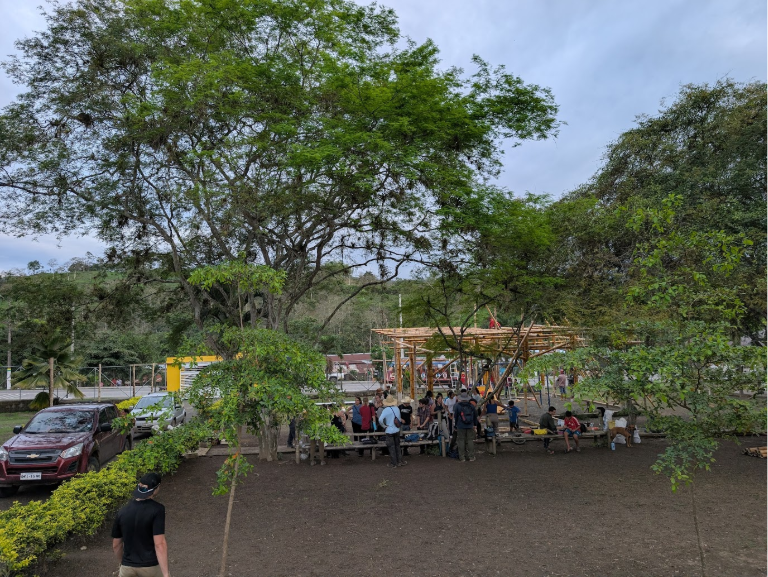
The main project we worked on throughout our trip was a playground shade for a school in the nearby town of Pavon. The playground had previously been shaded by just a tarp. This shade would allow the children to play on the structure regardless of the weather.
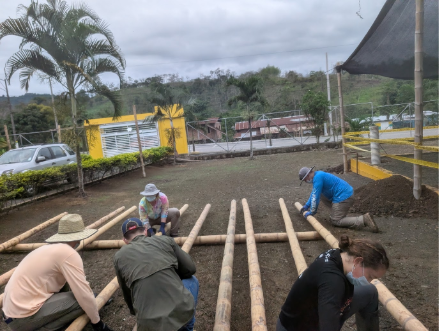
After our bamboo lessons with Jorge, we helped prepare the bamboo for use in construction, cleaning and sanding it before pieces were cut and assembled. There were three trusses in this structure, and some students were able to help with their assembly.
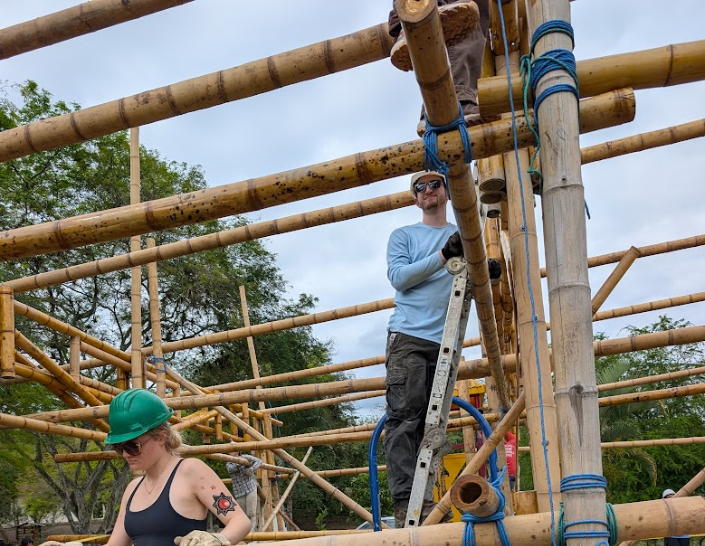
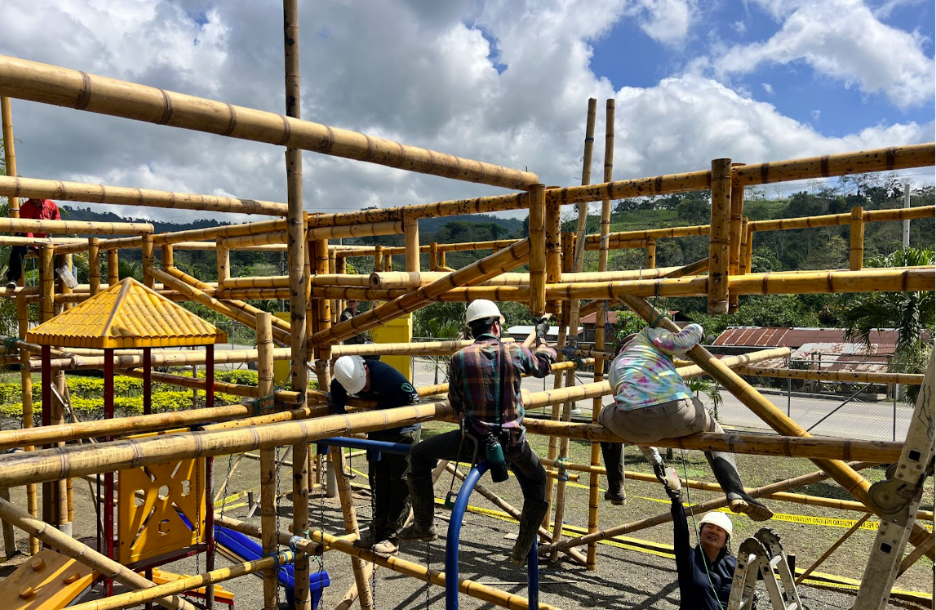
Once bolted together, teams of students helped to lift them into place, while the maestros and Jorge supervised their placement. The maestros have been working with bamboo for many years. They can fashion fish mouth joints in less than a minute, while we spent an hour making our less-than-ideal joints.
As more of the truss supports were properly connected, the scaffolding could be taken down incrementally. We applied varnish after the trusses were in place, which will help ensure the longevity of the structure.
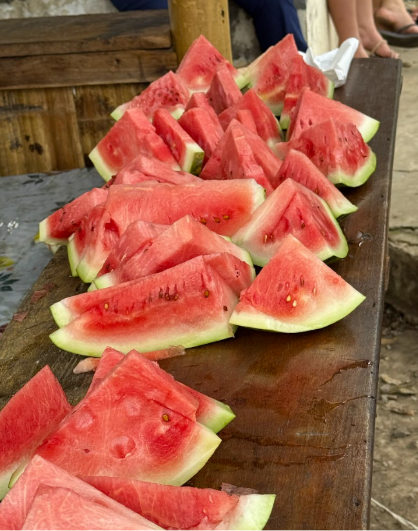
On the last construction day, we celebrated with some of the local students and families of the school, pruned their syntropic system towards the back of the property, and enjoyed watermelon!
When we weren’t working on these projects, we also had a few excursions planned by RFI that brought us closer to Ecuadorian culture. We visited a primary forest with a professor at a local university, got to tour a 120-year-old house made from bamboo, saw the inner workings of a cacao farm and chocolate production, and swam at a waterfall.
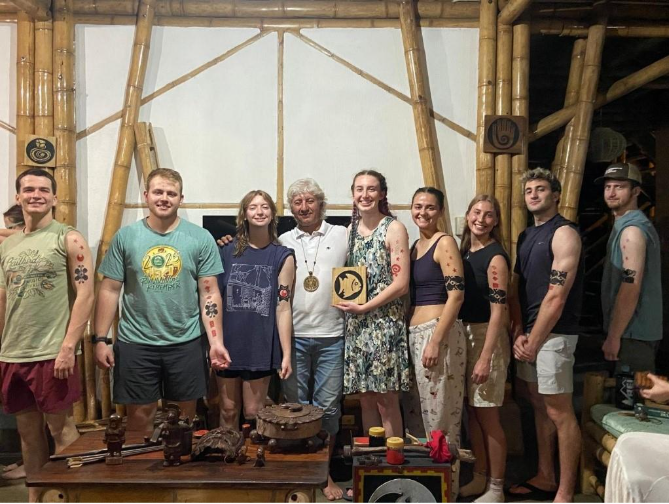
On the second-to-last night, we were visited by an artist named Ricardo, whose life’s work is to recreate artifacts found in the area that once belonged to ancient Ecuadorian cultures. He told us that using animal forms was highly important to the ancient people, to embody the characteristics of a particular animal to help with hunting or battle. He said that he himself is a bat, because he spends his time feeling around in the dark to understand the world. His artwork is inspired by ancient motifs, and he collects fragments of artifacts and works to reassemble replicas that inform current understanding of these ancient peoples. He guided us through an anthropological study of several artifact fragments, had us think deeply about what their purpose could be, and then provided an interactive experience where we could all get temporary tattoos that symbolized the elements. He and his son then offered art for purchase, and we bought this board from Guayacan wood, painted and carved with a symbol for water, as a gift to the WaTER center.
My third year at OU, only the 2nd time I have found out about the AASA Lunar New Year Celebration at the last minute. Somehow it crept up on me despite the fact that I always go and I started talking about Lunar New Year in December. At my friend Fiona’s house over break we discussed the year of the horse, which is her sister’s birth year. Her mom read us some nice Chinese proverbs about the horse, but we pressed her to find good ones about the monkey, which is our birth year. Whereas the horse proverbs read “When a horse arrives, instant success”, sayings referencing monkeys seem to have lower praise. Some memorable ones for me: “Monkey head monkey brain” and “When the tiger leaves the mountain, the monkey calls himself king”.
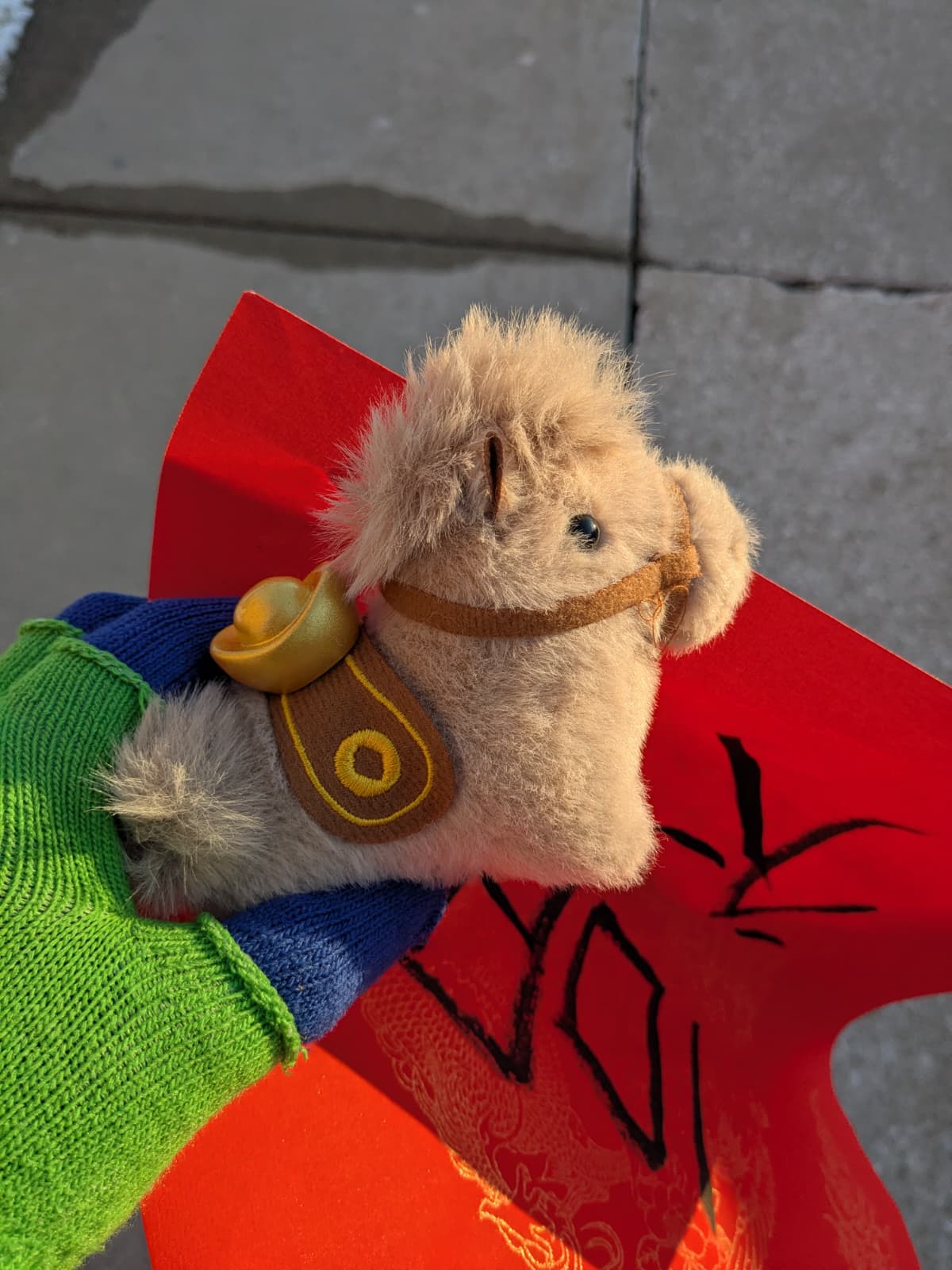
Fiona celebrated at UMich already, and sent me this picture a few weeks ago. She said she spun a wheel and answered a riddle to win it an Asian Student Association activity.
I am here to write this blog post for all my dutiful fans ( my friends know about this blog but very few of them have looked to find it, they feigned outrage when I said none of my posts were public anymore.) and for future me, who would find it easier to write about events sooner after they happen.
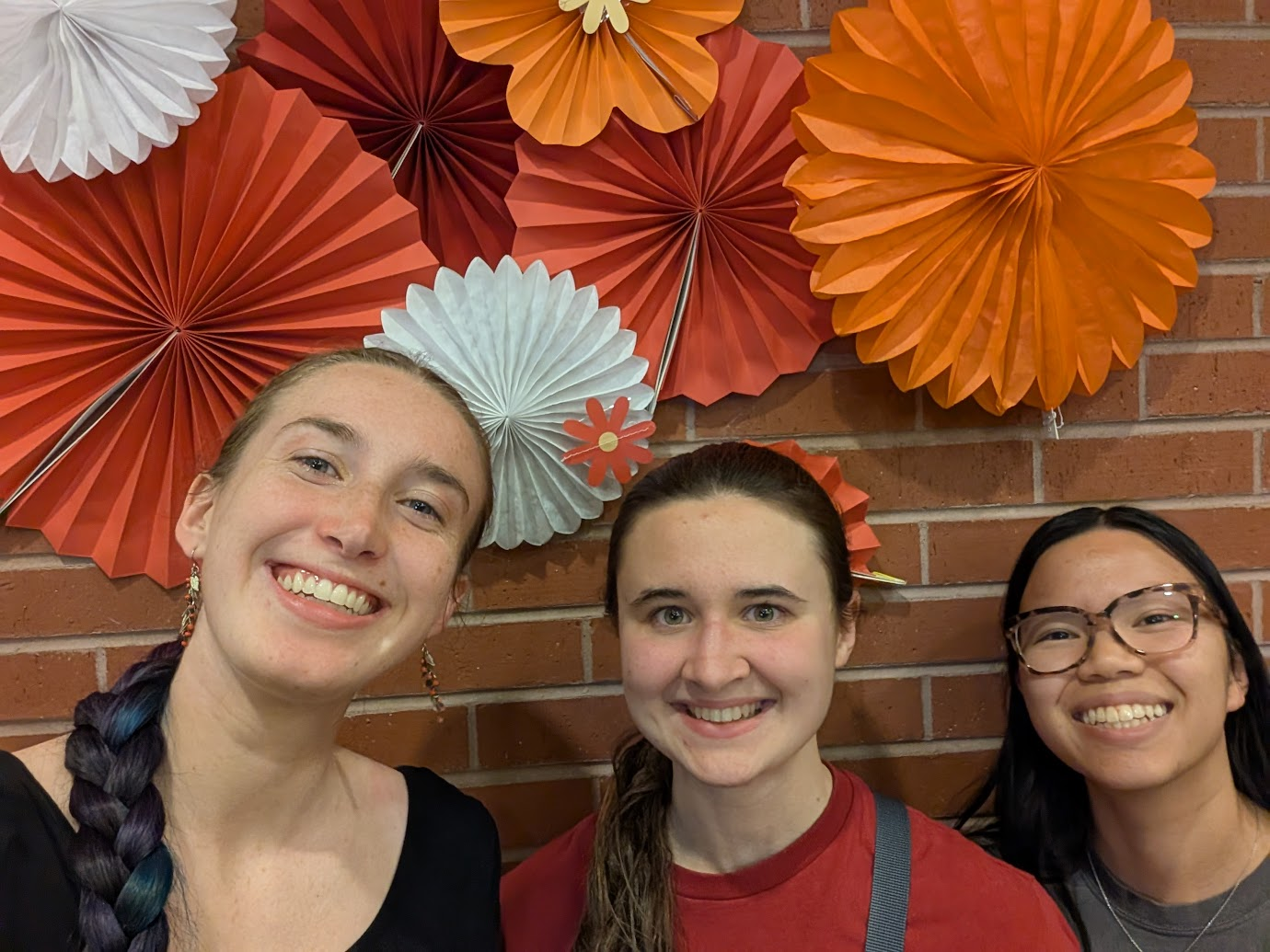
My friend Savanna and I planned to go, and at the last minute I convinced my friend Logan to come as well! It was great to have them with me to mill around.
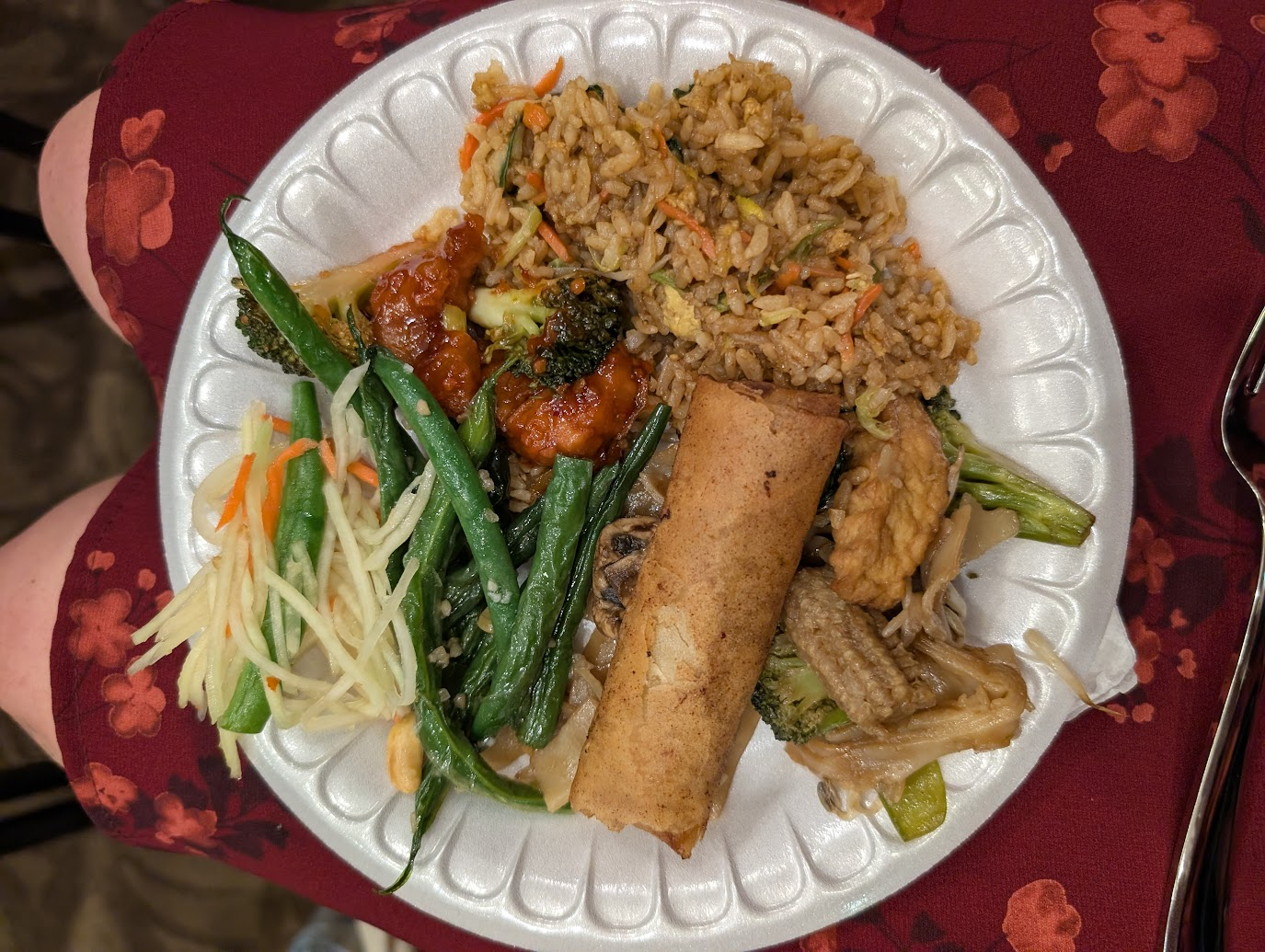
Every year I get here super early and just have to wait for the food and performances, so I went up to the Tapioka magazine booth again. At the booth we pestered Erik, the creative director and later MC, about the magazine. Last year the guy at the booth was really confusing, so it was only in the last 5 minutes of talking to Erik that it was clear the magazine was not actually in print physical copies. Also I don’t think he had read it himself. It is really cool that students can come together to make something like that, and he said they did get money allotted to them from the AASA this year to print and distribute some magazines, which is cool!
After half an hour, we got food, sat down and I noticed the girls behind us were speaking German. I summoned all my courage and the deep knowledge that if my mom were here, she would have 10000% have made me talk to them, and turned around and asked, in German, if they were German. This sounds stupid but it is a super easy way to indicate that you speak it, and it IS always possible they are from Austria or something! I talked to them a bit, asked why they were here (study abroad), what they were studying (to be teachers), and they said they had met one of the German instructors, Frau Preuss, also because she had heard them speaking German and came up to them. It wasn’t the longest or greatest conversation because the room was loud and I had to turn fully in my seat to speak with them, but I’m glad I did it and I never have to wonder what could have been…
We stayed for the dance and musical performances, unfortunately there were pervasive microphone technical issues, but the performers were all great! I never entered in a raffle, and I vow to make sure I do and to be able to stay until the very end next year. Happy Year of the Horse! Instant success!
 Global Engagement Fellowship