Every year, my family celebrates the Mid-Autumn Festival. This festival marks the celebration of the full moon, family, mooncakes, and gratitude. The event was traditionally used to worship the moon goddess, Chang’e, who drank an elixir of immortality to prevent it from being stolen and ascended to the moon, where she resides eternally. Worshipping her is an act of honoring her sacrifice and beauty.
I remember, as a young child, trying mooncakes for the first time and being in awe of their decadent shapes and colors. Not only is this a celebration of family, but it is also a time to reflect and be grateful for everything we have within this lifetime.
Within the Chinese community, it is a time to reunite with family and give thanks for the moon and the new harvest. I remember the bright colors and the beautiful tales of the moon goddess watching over our celebrations. Moreover, another key theme is avoiding foods and shapes that are not round to honor the full moon. Respecting the stories and culture that came before you is deeply evident in this tradition.
Overall, the Mid-Autumn Festival is a tradition that I cherish every year with my family as I grow older.
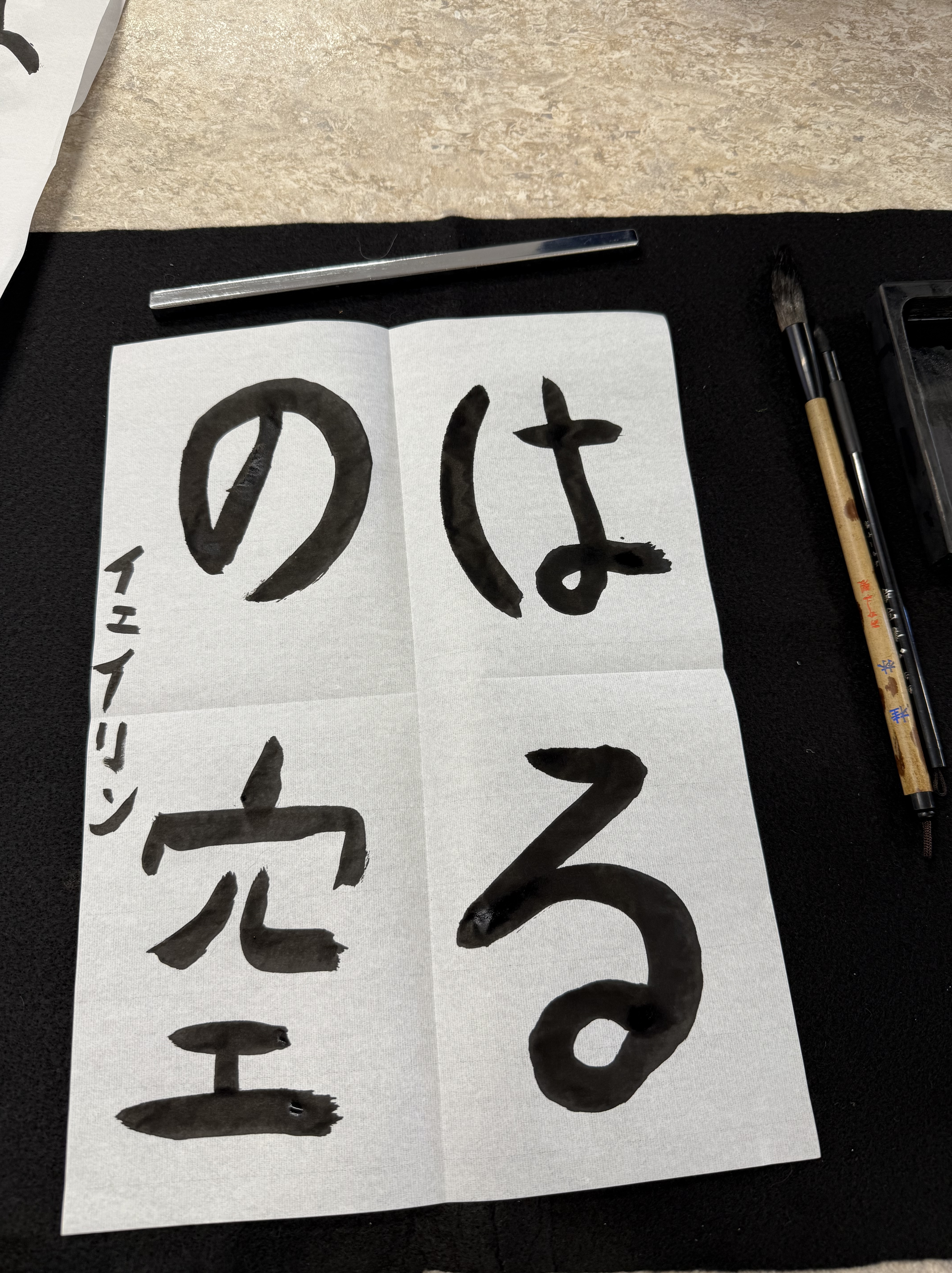
In February, I had the opportunity to attend a calligraphy workshop hosted by the Japanese department. This event was open to any student taking a Japanese language course. Coincidentally, this event came at the perfect time. This semester the topic of one of the chapters my class went over was Japanese culture and customs.
Calligraphy or 書道 (Shodo) is an art that has been used and adapted for centuries in Japan starting in the 6th century. It has Chinese origins and has developed into a unique art form that is practiced across the country. The name 書道 consists of two kanjis (Japanese characters): 書 meaning writing or to write and 道 meaning way or street. Literally translating to “way of writing.”
When practicing calligraphy, four things are used: a brush, ink, inkstone and paper. Brushes can come in all shapes and sizes. There are also several calligraphy styles including Tensho (ancient seal script) and so on. In the workshop we didn’t go over any particular style. We were just encouraged to start.
I will admit, it was very challenging. Calligraphy can take years to master and even then you continue to learn over the course of your life. That’s why it’s called the way (or path) of writing! The hardest part for me was applying the right amount of pressure to the brush to get the stroke correct. My finished product was not the best but it was definitely legible.
The characters we wrote were はるの空 (haru no sora), meaning spring sky. We also wrote our names, in katakana, in smaller writing on the left. Katakana is the alphabet usually used for foreign words.
I’m so glad I had the opportunity to attend this event. It was a challenge but it was also really fun! I’d love to do it again and I recommend trying it at least once!
This past Spring ’26 semester, I had the privilege of being a part of the Graphics committee within Tapioka, an Asian-American magazine. My role within the committee was to assist with any graphics needed for a writer’s piece or pitch, which could consist of a photo shoot or a written column. Not only did I assist with graphics, but I also contributed through makeup at some photo shoots and even modeled for another.
This organization inspired me to become more engaged on campus and become a better contributor to OU as a whole. This role changed my beliefs about which skills would be best utilized for my International Business major and instead showed me that my interests do not all have to align with a single path.
Before I joined, I was firmly set on only growing my hard skills in Excel, marketing, and sales. However, after getting the opportunity to become more involved creatively, I realized the extent to which I had been limiting myself. Just because I have a specific career in mind does not mean I need to give up on the hobbies or passion projects I may be a part of in the future.
Overall, Tapioka holds a special place in my heart, allowing me to express myself creatively while navigating this new life that college has given me. The love I have for art has been truly reignited after exploring this passion!
This event was the first AASA event I attended during my second semester! I had the opportunity to interact with countless new people, eat incredible food, and enjoy my time as a freshman.
One thing not many people talk about is the difficulty of meeting new people on campus. While I have met many, I have found that I’m always happier when getting to interact with a new crowd. The AASA Lunar event not only brought a huge number of people to AASA but also to countless other organizations. As I looked around the room, I got to see a community that was more interconnected than I had anticipated.
However, I did not arrive on time to this event, so I unfortunately was left with leftovers that, while delicious, were otherwise very cold. Throughout the course of the event, I had the lovely opportunity to see friends of friends that I had met maybe once or twice.
One key moment was sitting up and back down to say hi to people and striking up conversations with others that I hadn’t yet met. Overall, the energy in the Dunham dining hall was simply magical and a wonderful experience to have before the end of my freshman year.
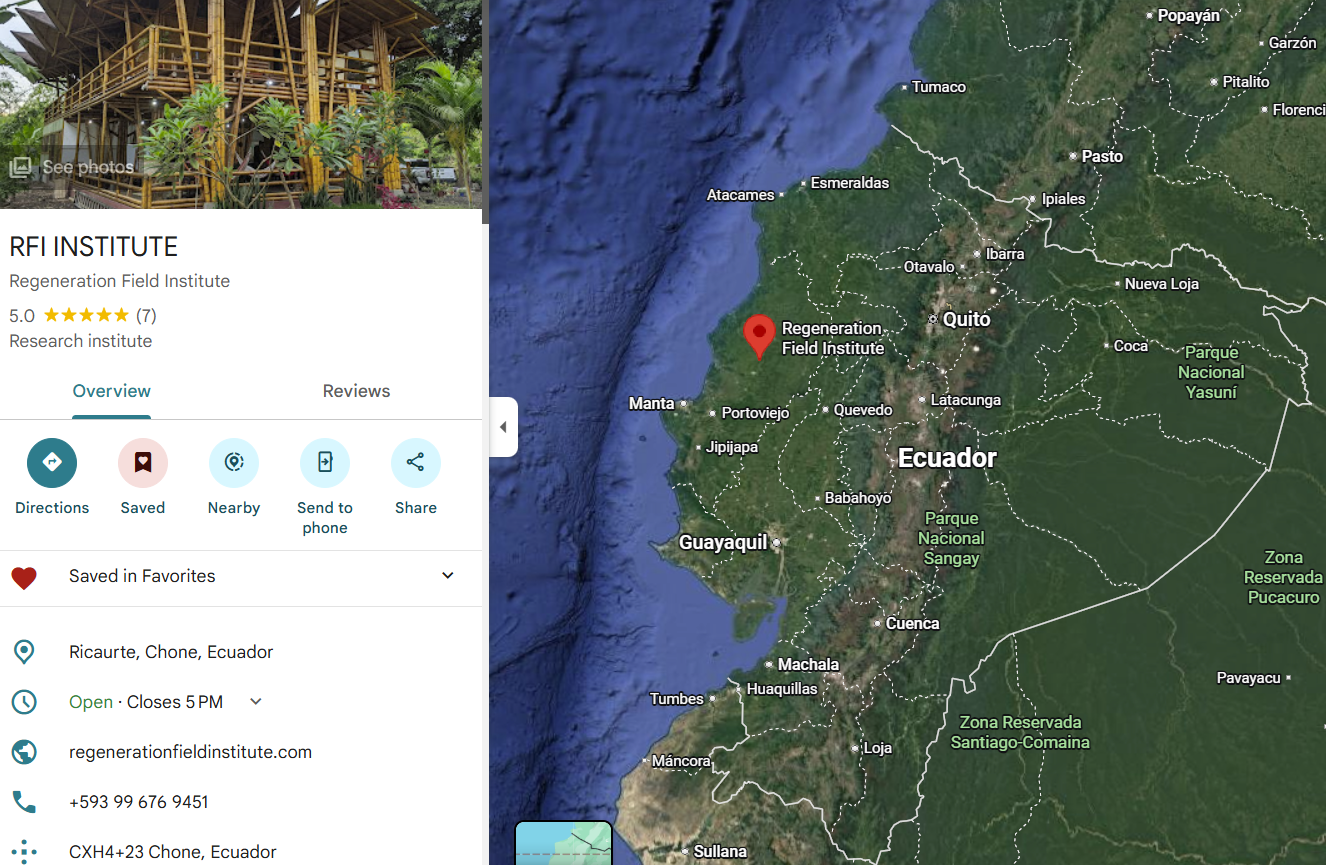
Sooners Without Borders is a Registered Student Organization active under the Gallogly College of Engineering at OU. I am the Vice President, and my friend Victoria Gilfillan restarted the club’s international service trip tradition this year, as we coordinated a trip to take 11 OU students to Chone, Ecuador.
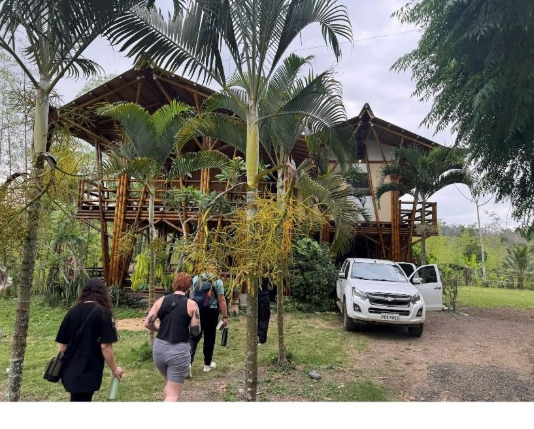
Travel began January 7th, 2026, and all students arrived in the morning of January 8th at the Quito airport. For this program, the 11 OU students were joined by 12 UC Berkeley students, totaling 24 for our program. From the airport, it was an 8-hour bus ride to the RFI farm. The journey from the mountains of Quito down towards the coast consisted of fog, hairpin turns, and the discovery that bathrooms are BYOTP.
Students arriving at the RFI farm in Chone, Ecuador, on January 8th, 2026.
Upon reaching the farm, we chose bunks, were served dinner, and spent our first evening getting to know the UC Berkeley students and each other better. Our general schedule was a 7:00 am wake-up call, breakfast, morning work, lunch, afternoon lesson/lecture, dinner, showers, evening work/lesson, and quiet hours at 10:00 pm. Although this schedule was followed very loosely, we were up in the morning at 7 at the latest, and in bed by 10:30 at the earliest. Our 9-day trip was extremely full of activity, learning, and making new connections!
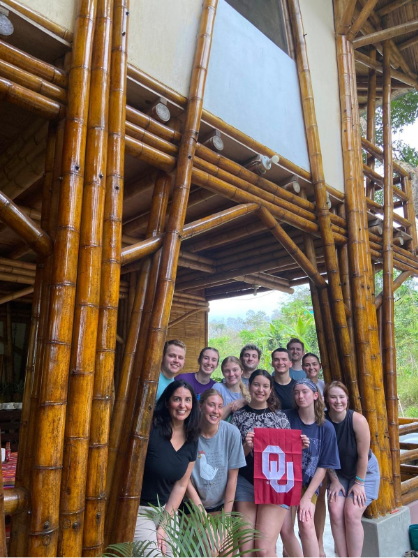
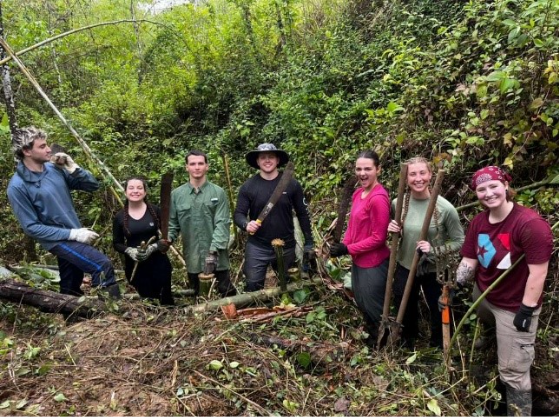
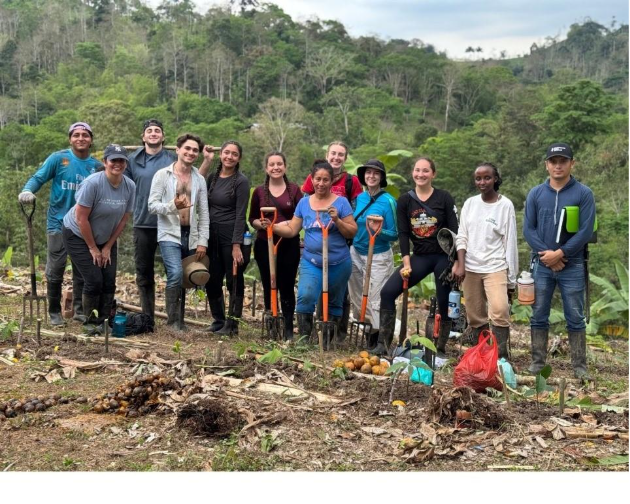
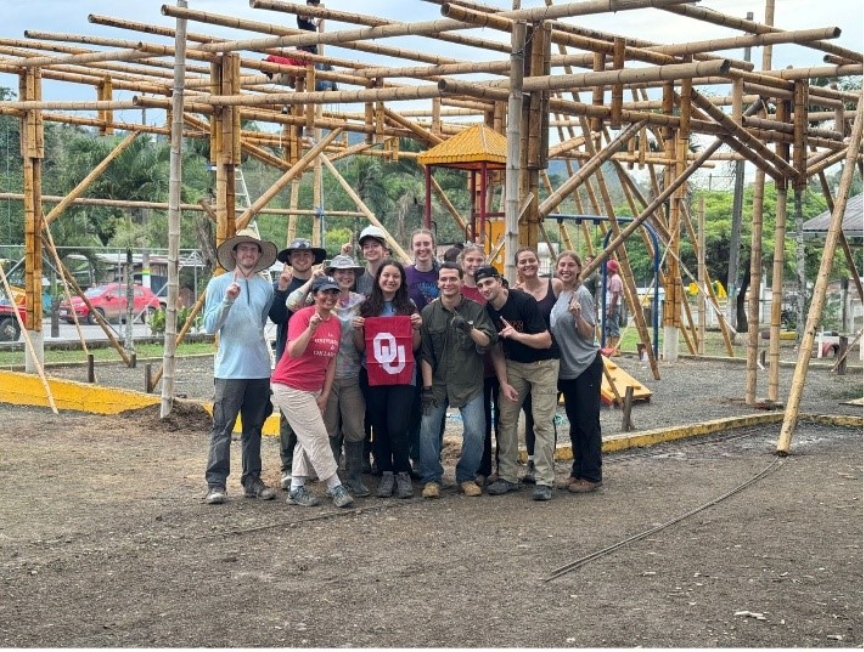
First group photo at the farm! From left back row: Trent Rogers, Audrey Hirchert-Walton, Victoria Gilfillan, Jaden Sloan, Chaz Hall, Travis Lloyd, Jimma Fuson. From Right front Row: RaCamie Bover, Julia Robbins, Izzy Harris, Ashlyn Olmsted, Lisa Morales.
On our first day, we got a tour of the farm and learned more about RFI’s mission. We then had the first of several bamboo lectures from Jorge Loor Ocampo. Jorge is an architect who works with RFI on bamboo projects and instructs programs like ours. During these lectures, we learned about the advantages and limitations of bamboo as a building material, how it is prepared and used in the best practices, especially in projects like ours, which gave us a better understanding of the structure we would be working on. We also had hands-on learning experiences in workshops on the farm, from carrying bamboo to shaping the characteristic “fish mouths” needed for joining bamboo in structures.
We also had the opportunity to learn about RFI’s syntropic agroforestry systems implemented on their own farm and other local farms. Upon touring the farm on the second day, we saw the rows of diverse plantings that are working to provide shade and biomass to restore rich jungle soil quality. At this point, our leaders separated us into three groups to work on various projects around the farm. The projects we worked on at the farm were “Bamboo Dams” and “Living Edges”.
The bamboo dams served to retain valuable topsoil and reduce sediment pollution during seasonal heavy rains. Bamboo was cut nearby on the farm, transported by us to the gully we were damming, hand-cut and hammered into place by rotations of groups. As the dams are biodegradable, the hope is that over time, the soil will build up behind each placed dam and reduce the dramatic slope in the area, providing more usable land.
Students working on the bamboo dams.
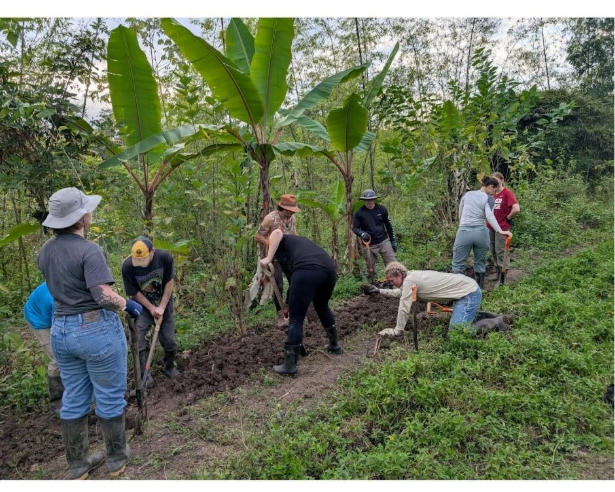
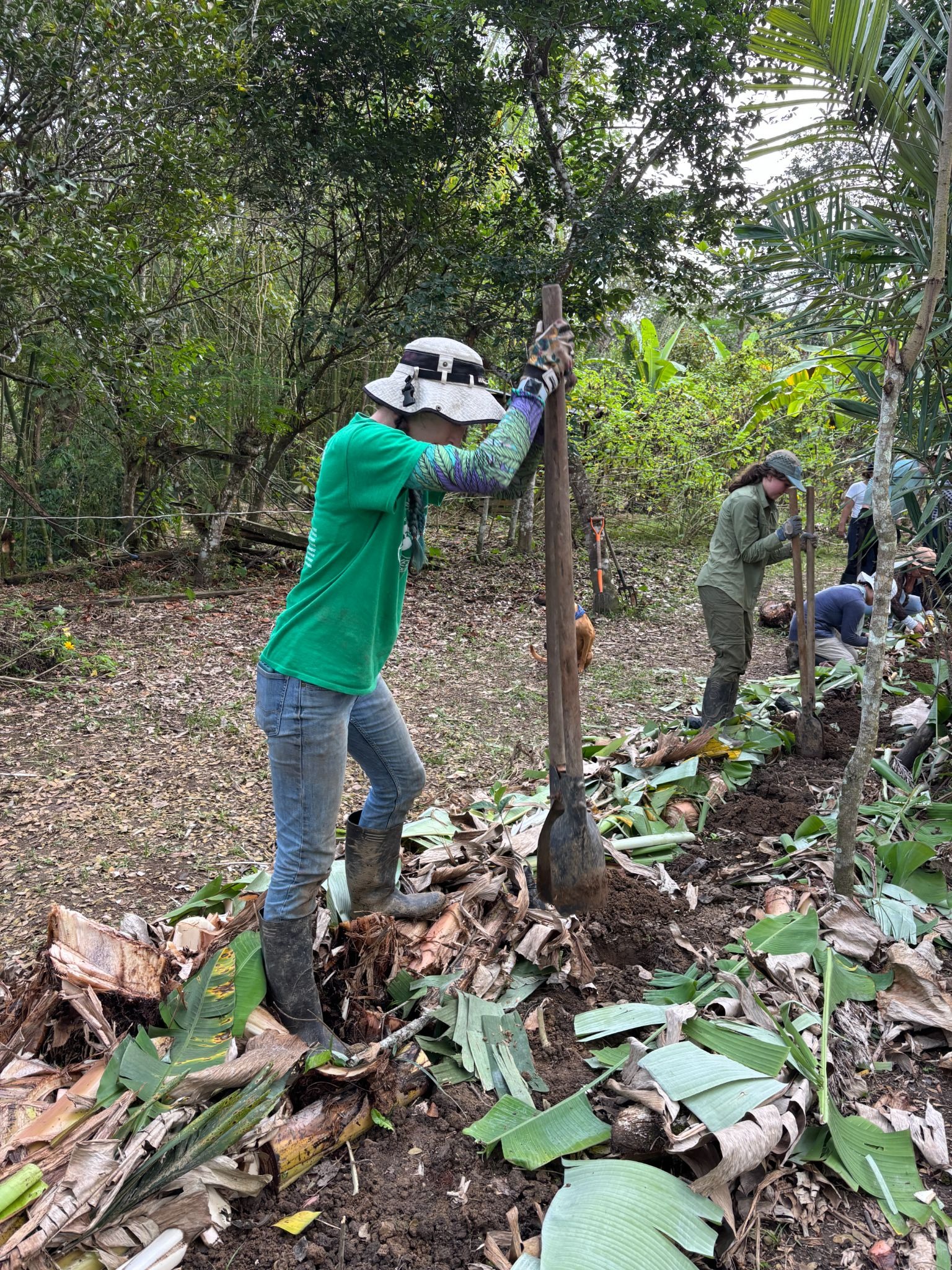
Living Edges is the project lining the pathways on the farm, encouraging so-called “bio-corridors” that can be a hub of biodiversity connecting different areas of the farm. We first had to work to loosen the soil, which we did using the strategy of “double digging”, the same method commonly used in the Peace Corps agriculture sector. Our club advisor, Mrs. Lisa, and RFI’s trip leader, Chris Galena, had both served in the Peace Corps in Paraguay and were well-practiced in the work. These plantings lining the pathways will help to spread native plant species throughout the farm and provide habitat for animal species, such as howler monkeys, to move with ease around the area.
Students double-digging for bio corridors.
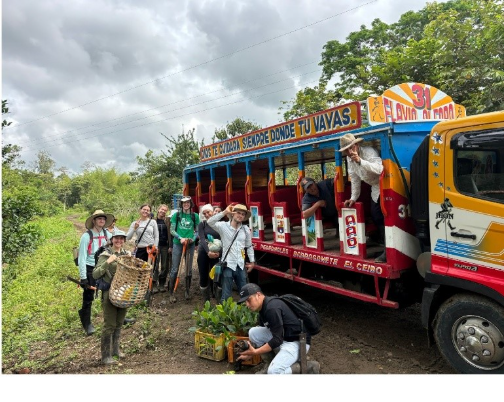
One of the most rewarding activities we participated in was the “mingas”, which brings together many community members to work on one farm for a concentrated period of work. The idea is “today for you, tomorrow for me”, and was a great opportunity to connect with the local farmers. We traveled in an open bus as close as possible to the job sites, but had to go on foot when the roads were not able to accommodate our large vehicle.
Students unloading the bus to begin work at their minga.Me, digging a hole to place seeds in
We transported heavy loads of plants, stakes, seeds, and tools to the sites and helped plant highly diverse rows of plants that would be the base for syntropic agroforestry systems on these farms. When we traveled to the mingas, we had “tongas” brought to us for lunch. Tongas are mixtures of rice, plantains, peanut butter, and chicken wrapped in a banana leaf for transport. This natural packaging allowed us to dispose of our leftovers right where we were sitting. It’s freeing knowing everything you consume can go right back to the land you stand on.
One group at a minga site, after loosening soil and planting the first section of the syntropic system.
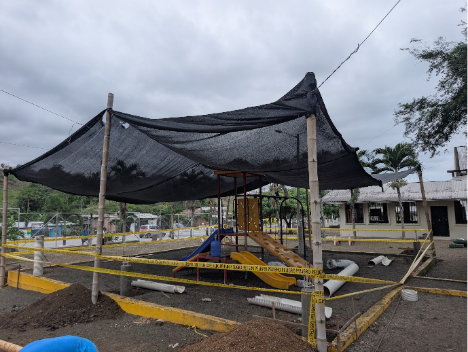
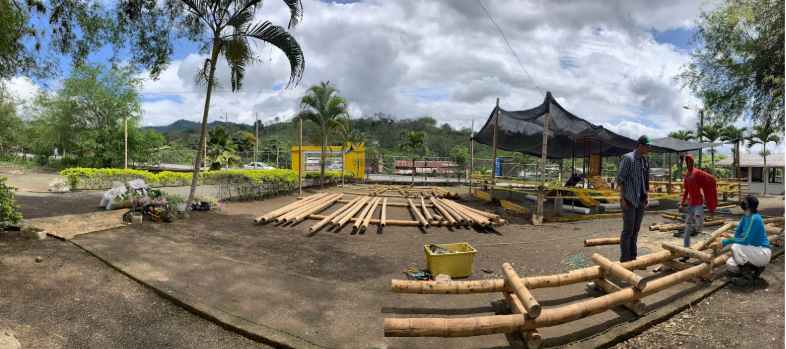
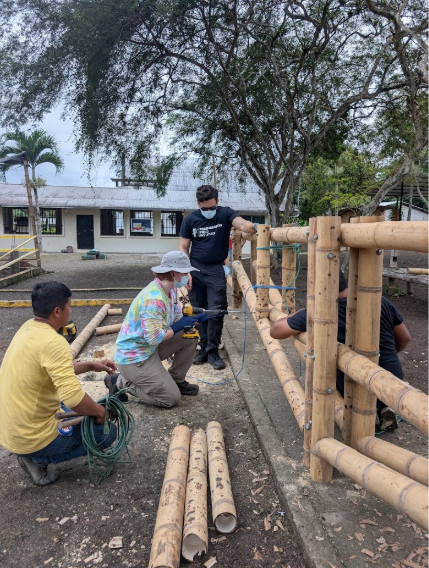
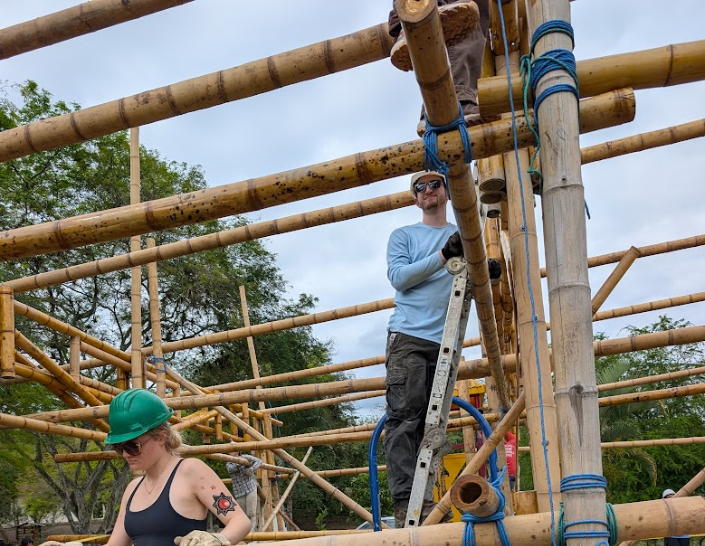
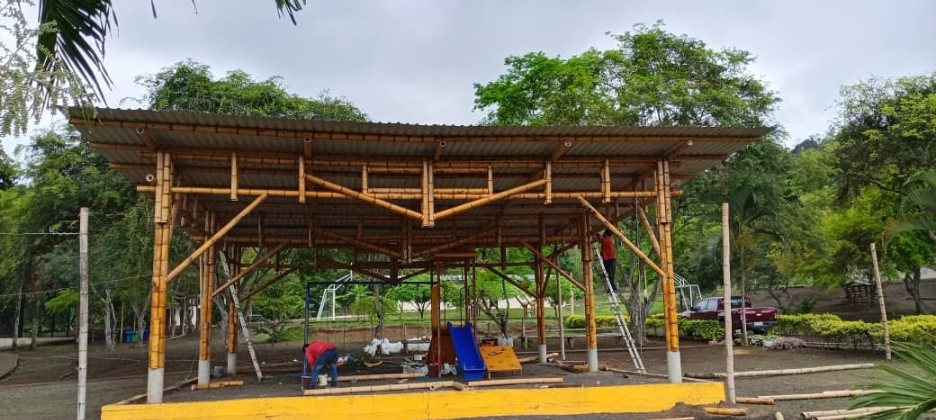
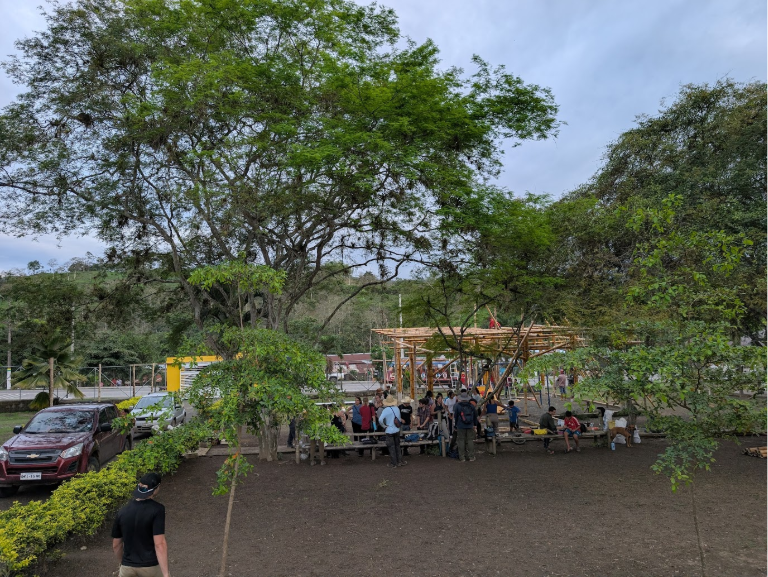
The main project we worked on throughout our trip was a playground shade for a school in the nearby town of Pavon. The playground had previously been shaded by just a tarp. This shade would allow the children to play on the structure regardless of the weather.
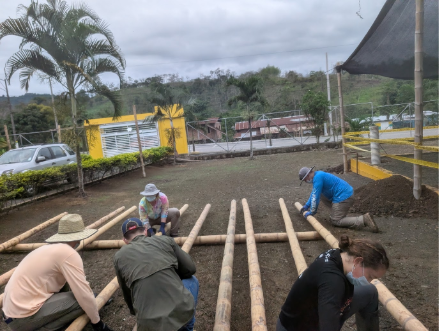
After our bamboo lessons with Jorge, we helped prepare the bamboo for use in construction, cleaning and sanding it before pieces were cut and assembled. There were three trusses in this structure, and some students were able to help with their assembly.
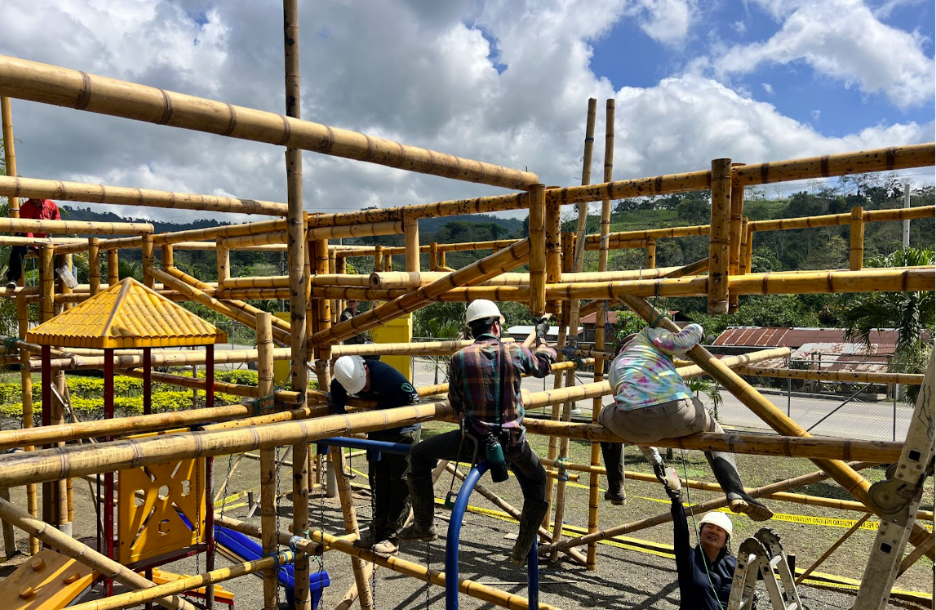
Once bolted together, teams of students helped to lift them into place, while the maestros and Jorge supervised their placement. The maestros have been working with bamboo for many years. They can fashion fish mouth joints in less than a minute, while we spent an hour making our less-than-ideal joints.
As more of the truss supports were properly connected, the scaffolding could be taken down incrementally. We applied varnish after the trusses were in place, which will help ensure the longevity of the structure.
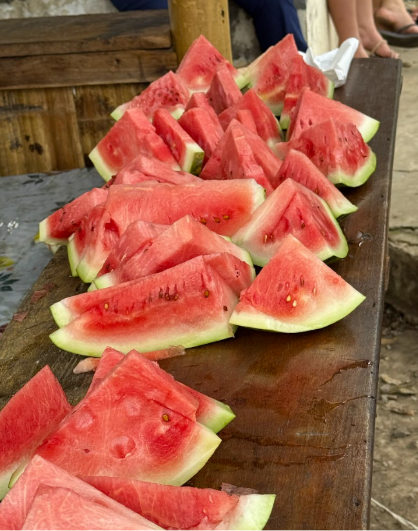
On the last construction day, we celebrated with some of the local students and families of the school, pruned their syntropic system towards the back of the property, and enjoyed watermelon!
When we weren’t working on these projects, we also had a few excursions planned by RFI that brought us closer to Ecuadorian culture. We visited a primary forest with a professor at a local university, got to tour a 120-year-old house made from bamboo, saw the inner workings of a cacao farm and chocolate production, and swam at a waterfall.
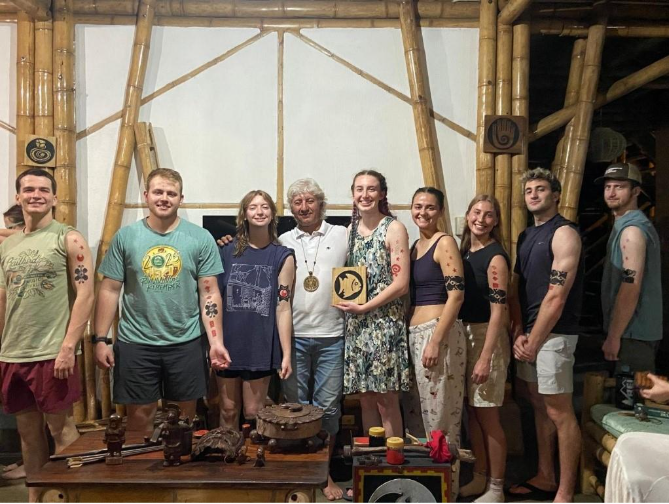
On the second-to-last night, we were visited by an artist named Ricardo, whose life’s work is to recreate artifacts found in the area that once belonged to ancient Ecuadorian cultures. He told us that using animal forms was highly important to the ancient people, to embody the characteristics of a particular animal to help with hunting or battle. He said that he himself is a bat, because he spends his time feeling around in the dark to understand the world. His artwork is inspired by ancient motifs, and he collects fragments of artifacts and works to reassemble replicas that inform current understanding of these ancient peoples. He guided us through an anthropological study of several artifact fragments, had us think deeply about what their purpose could be, and then provided an interactive experience where we could all get temporary tattoos that symbolized the elements. He and his son then offered art for purchase, and we bought this board from Guayacan wood, painted and carved with a symbol for water, as a gift to the WaTER center.
Throughout this semester, I became more interested in connecting with my Chinese heritage, so attending the Chinese Lantern Festival felt like a natural and exciting step. While at the event, I had the pleasure of running into my past and future Chinese professors, as well as enjoying a delicious Chinese meal.
When I first arrived at OU, I felt a sense of isolation due to the lack of visible Chinese diversity and cultural representation on campus. This is not to say that the Asian community does not exist here, but rather that finding specific Chinese cultural representation was more difficult than I anticipated. Because of this, I became interested in the Chinese Student Association immediately after it was formed. I first learned about the festival from my teacher, Gao Lao Shi, who encouraged our entire class to attend campus events throughout the year to become more engaged.
When I arrived at the event, the room was packed with numerous faces I had yet to meet. As the evening went on, I felt a growing sense of being at home, surrounded by the sound of fluent Mandarin speakers and the vibrant energy of the room. The traditional meal, down to the last bite, reminded me of the culture I had longed to experience and be a part of again. As I continue to learn Mandarin and dream of studying abroad in China, the Chinese Lantern Festival reignited a passion for the heritage I thought had passed my life by.
As I transition into my sophomore year, I look forward with joy and ambition to attending the Chinese Lantern Festival once again.
This year, for my cultural organization involvement, I decided to join OU Cousins. OU Cousins is a program designed to bridge friendships between international students and US students to promote cultural knowledge and exchange. After filling out a questionnaire, you are matched with your OU Cousin and spend the semester getting to know one another. OU Cousins also hosts events throughout the year to build community. This was my first time participating in this program, so I was really excited to meet new people.
My OU Cousin is from Seoul, South Korea, and I really enjoyed getting to know her more over the semester. We attended the annual OU Cousins Barbeque together, where I got to meet some of her friends and other students. She is only here for the semester as part of her exchange program, but it was cool seeing what she thought about Norman and other places she had visited in the US. I also enjoyed getting to know more about Seoul, as I have never been there before, but I would love to visit someday. She liked listening to what my life is like in the US as well. We are also both business majors, so it was cool learning about how the university system works in South Korea. Overall, I had a great time in this program and getting to know more about the international students here at OU!
I will definitely continue my participation in this program, and I hope to meet even more people to get to know more about different cultures!
The Met Gala is one of the biggest nights in fashion – and last night was no exception. The overall theme for the 2026 Met Gala was “Costume Art,” and the dress code was “Fashion is Art”. Something I wanted to highlight from the Gala was the Indian fashion. Indian fashion has been earning its well-deserved recognition in both the Western and global fashion arenas, but it has not always gotten the credit it deserves. Indian fashion is extremely diverse, made of beautiful fabrics, vibrant colors, and incredibly detailed embroidery. Let us do a deep dive into some of the amazing looks showcased at the Met Gala.
One of my favorite looks was that of Karan Johar, a filmmaker. Johar wore a jacket featuring hand-painted visuals inspired by the Indian painter Raja Ravi Varma. The artists spent 5,600 hours bringing this vision to life. The paintings depicted men and women in traditional Indian clothing and jewelry. As a filmmaker, Johar understands the importance of telling a story through visuals, and his Met Gala debut was no exception. Another look that I loved was Manish Malhotra’s, a fashion designer. He wore a black bandhgala suit with an elaborate cape that featured mini sculptures and embroidery of Mumbai landmarks and other aspects of Mumbai city life. Additionally, the artists who worked on the outfit had their signatures embroidered into the cape as well, showing the people behind the scenes. Another showstopper look from last night was from Sudha Reddy, a businesswoman and philanthropist. Her outfit was inspired by the Tree of Life painted in the Kalamkari style, a painting style that originated in the states of Andhra Pradesh and Telangana. Kalamkari is typically painted on fabrics, so including it on the outfit is right on theme in many aspects.
Indian fashion is finally getting its moment on the global stage. Indian fashion is truly unique and diverse, with so many intricate and beautiful stylistic qualities – making it art in its own right.
Hello! This is going to be (probably) my favorite post this semester. I’ve worked out a list of my favorite phrases/words I’ve heard people from Scotland or England say while I’ve been attending university abroad. I’m also adding the “American” translations where applicable as well as a sentence for context.
To give a brief background on this, each time I meet someone at university that isn’t an exchange student, they pretty much always like to point out the things that we say differently in the US compared to Britain. A lot of the time in conversation, I feel myself having to ask what phrases and words mean because I simply can’t assume the meanings. I’m lucky enough to have made friends who have no issue with explaining things to me, and it’s actually been really helpful to have people I can ask questions to who are actually from Britain.
Now for the phrases and words! The list below has 4 of my favorite and the most memorable words and phrases I’ve learned since studying in Scotland. Enjoy!
Phrase: Waffling Around
Definition: To talk about nothing essentially; to ramble about useless information
Sentence: She was just waffling around.
Reason why I love this phrase: When I really get to thinking about it, waffle is an odd word, so using it in a fun way is totally justifiable. I would have never come up with this on my own, but I will be adopting this phrase into my daily life.
Word: N.E.D.
Definition: Stands for “Non educated delinquent”
Sentence: I feel like I’m out here walking around like a Ned.
Reason why I love this word: I find it funny. There are just certain things that make you laugh, and for me, this is one of them. It’s an easy add to your vocabulary, and I was told that it’s very Scottish which is a bonus.
Word: Cheeky
Definition: Cheeky?
Sentence: You can’t leave without having a cheeky Nando’s.
Reason why I love this word: It’s inserted in areas of conversation that sound so natural to the people that are from the UK, but to me it stands out every time. (In a good way though) I just love how this adjective is used so often, but doesn’t actually carry much of a unique meaning. It’s like it’s just there because they can put it there.
Word: Cheers
Definition: Thanks
Sentence: Cheers!
Reason why I love this word: It’s so British. You would never hear anyone say this in the US unironically, so everytime I hear it in the UK I’m reminded that I am in the UK. It’s just one of those British words that sounds so British to someone who is still getting used to the accent. And update: yes I’m still getting used to the accent even towards the end of the semester. They never fail to surprise me.
I’ve tried my best to ask as many people as possible if these are their definitions of these words, but it does vary from person to person, so I can’t promise you everyone will think these are the correct meanings. I hope you found at least a few of these words and phrases interesting. If I come back with a new vocabulary, now you’ll know why!
My first few weeks here in Scotland, the only “true” cultural experience I really felt like I received was the dreary weather. As time went on, I began to learn more and more about the culture, but there was one night that really cemented my idea of “Scottish Culture”. Introducing…Burns Night!
Burns Night is one of the Scottish holidays. I’ve asked people who are from Scotland which holidays they have that really celebrate Scotland as a country, and without fail everyone’s answer is Burns Night*. Burns Night was celebrated on January 25 of this year (2026), but because that’s a Monday, it seemed that the whole weekend was full of festivities. From what I understand, the festivities vary by area of Scotland, but most places have a ceilidh.
Burns Night is the one night a year that the Scots celebrate the poet Robert Burns. Now I actually believe most people in the US know of Robert Burns’ works, but may not know him by name. He’s written some very famous poems, as well as the song of New Year’s Eve; Auld Lang Syne. In Scotland, he has his own holiday and is pretty heavily celebrated. To be honest, before I got here I really didn’t know much about him, but in at least 3 of my lectures someone has brought him up. Needless to say, the Scots put high value on Robert Burns.
Back to the information about the ceilidh. This is where I would like to mention that I actually got the opportunity to go and experience a ceilidh firsthand for Burns Night. It was incredibly fun and unique for me. I believe that going to the event also finally helped me get settled in with the city and get out of the homesick slump. Of course, by now, there have been plenty of other cultural experiences and events I’ve been to but I’ll be outright and say that this was the most memorable.
A ceilidh is a traditional Scottish (and Irish) event with storytelling, dancing, and food. It’s a time for the community to get together and just celebrate in an informal setting. I was invited to a ceilidh put on by my university and along with dancing, we were promised food. Since it was Burns Night, the food was “traditional”. A.K.A. Haggis, neeps and tatties. Or haggis, turnips, and potatoes. I went with my flatmates, and we spent hours learning traditional dances, as well as eating (what up until that point had been the best) food we’d had so far.
The dancing was amazing, and we were all out of breath by the end of each song. The university provided live musicians and the “caller” which was a student who taught us the dances who was also a musician. The dances were creative, but predictable enough that it was easy to catch on. We ended the night with Auld Lang Syne (a Burns specialty) before heading out.
I know that you may be thinking about my mention of haggis, and even more so about how I just glossed over it. I didn’t really mean to, but I will mention that I liked it. This may be a hot take (obviously not to the Scots) but haggis was actually really good! I’m not a picky eater, which helps a lot when trying new foods from other countries, but I was happily surprised when I tried it. My flatmates also approved (with the exception of one) and by the time we left, we were full and happier than we’d been in a while.
Overall, my experience at the ceilidh on Burns Night was one that I’ll never forget. I’m hoping to go to another ceilidh while I’m here, but if you’re ever in Scotland on January 25th just know that I would 100% recommend attending one in honor of Burns Night.
*Side note: every time that I ask this I am also reminded how much the US really celebrates itself. Fourth of July, Thanksgiving, President’s Day… And by no means is this bad, it’s just an interesting thing to note when comparing Scottish culture to American culture.

 Global Engagement Fellowship