In my history class, we had a short photography unit. In the unit, we explored how complicated the relationship between a photograph and a historian can be, especially since it’s often the only link to a specific time period or event.
Our professor challenged us to find photographs for a presentation where either they were debated to be a hoax/staged—even if initial reception was positive—or a photo that sparked backlash for other reasons.
My peers presented a myriad of different photos. From the infamous Loch Ness Monster photo taken in 1934 that is now known to be doctored to the heart-wrenching photo Napalm Girl taken during the Vietnam War, with people now debating who actually took the photo. I learned a lot more about photos I had encountered thanks to my peers.
I chose the photo Tank Man for my presentation. I had struggled trying to pick a photo, and then as I was scrolling through lists of controversial and impactful photos, Tank Man popped up, and I knew it would be the perfect photo to write about.
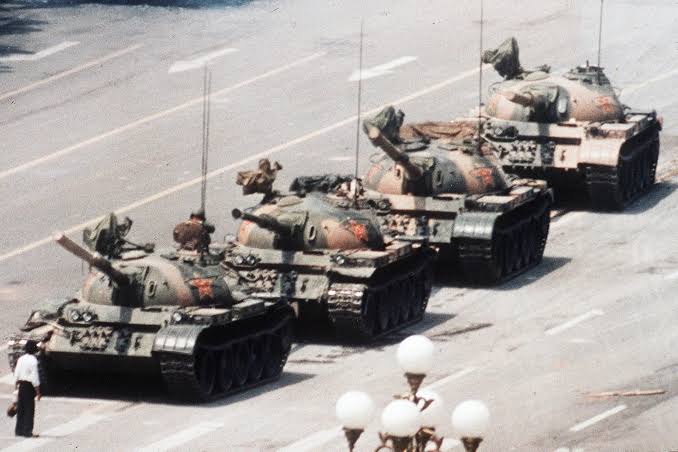
On June 5th, 1989, Jeff Widener took a photo that would forever be known as Tank Man. In April of 1989, pro-democracy protests erupted in China that were started by university students to speak out against the Chinese Communist Party. They were peaceful, and it wasn’t until June 3-4th that the government began to crack down on the protestors in Tiananmen Square. The government rolled in heavy tanks and told troops to open fire on protestors. The violence and hostility were not only directed toward the protestors but journalists and photographers as well. Jeff Widener, a photojournalist with the AP, had to smuggle his camera equipment past hotel security. Thankfully, an American guest staying at the hotel helped him do so. Unfortunately, he did sustain injuries; before getting to the hotel, he was struck in the head with a rock. Still, he was able to capture a photograph that would become one of the most infamous images of the massacre. It would be known as Tank Man, which depicts a man in a stark white button-up standing in front of a line of tanks. There’s even video of the man that provides further context, where he can be seen getting onto the tank and having a conversation with the soldier operating the vehicle. Later, “tankman” can be seen getting dragged away by bystanders. No one knows who he was or what happened to him.
Widener had captured the image from the hotel room, and it was not an easy task for Widener to get the photo out of the country. He, along with other photographers, had to smuggle photos out of the country as China had begun cracking down on foreign press and their coverage. The impact of Tank Man was immediate. People saw the bravery and defiance acted out by “tankman” and were in awe of him. Yet, there were some who did not fall into that infatuation. A Japanese journalist named Kato Harunobu, working with NHK, thought the event was staged; he believed that many details didn’t add up. One thing he mentioned was that he felt “tankman’s” bright white shirt was reminiscent of what military personnel wore, so he could have been a soldier with the military made to look like a civilian. Another thing Kato mentioned was how convenient it was that the incident occurred near the hotel where foreign news journalists and photographers were stationed. Kato also noted how the military had been brazenly killing protestors for days at that point.
Journalists didn’t just think the event was fake, but now young Chinese citizens do too. The Chinese government has strict censorship rules, and it has gotten rid of most of the information regarding the Tiananmen Square Massacre, known as “The Great Forgetting.” For example, books in China don’t even mention the massacre. Another thing the government got rid of is the photo itself, so most of the younger generation have never seen the photo before, with many of them saying things such as, “Is it from South Korea?” It’s difficult to imagine that such an impactful and violent event could be erased in the blink of an eye, but unfortunately, through the government’s power, it was.
I was more than glad to research and talk about Tank Man. I first saw the photo in my sophomore year during my World History class, and I was immediately in awe of the bravery of the nameless man; I was even more shocked when my teacher showed us the actual video of “tankman.” Despite what may have happened to him, he remains immortalized and celebrated in many places around the world.
Read more: An Image of Bravery Britannica Editors. “Tiananmen Square incident.” Encyclopedia Britannica. Last Modified, August 25, 2026. https://www.britannica.com/event/Tiananmen-Square-incident.CNN. “The Story Behind the Iconic “Tank Man” Photo.” Accessed October 15, 2026. https://www.cnn.com/interactive/2019/05/world/tiananmen-square-tank-man-cnnphotos/.
The New York Times. “Behind the Scenes: Tank Man of Tiananmen Square.” Accessed October 16, 2026. https://archive.nytimes.com/lens.blogs.nytimes.com/2009/06/03/behind-the-scenes-tank-man-of-tiananmen/.: An Image of Bravery

